
Reviewed · WALKING TOURS
Beijing Historic City Guided Walking Tour + Calligraphy Creation
Beijing’s past comes alive in the lanes between its major sights. This 3.5-hour walk moves from the 1807 Huguang Guild Hall through old hutongs, art shops, food streets, and Qianmen, giving you a closer look at daily city life than a standard monument tour. I like the small-scale streetside view of Beijing and the way guides such as Kris and Hao mix dates with stories about food, work, and family life. I also like the stop at Liulichang, where calligraphy and old-style arts give the walk a hands-on cultural angle.
The main catch is the tips-based price. The $5 fee reserves your place, but the operator suggests an additional tip of 160 to 200 RMB, or about $20 to $25. Also, this is not a Tiananmen Square tour. You finish nearby, but you do not enter the square.
Key points to know before you book
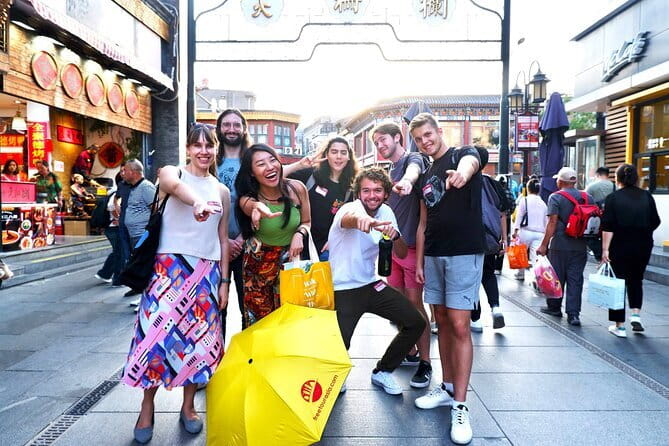
- Walk from Huguang Guild Hall to Qianmen: The route links six areas in southern central Beijing rather than focusing on one major monument.
- Old hutongs are the heart of the tour: You spend about an hour in traditional lanes and residential areas.
- The $5 price is only a reservation fee: The tour uses a voluntary tipping model, with 160 to 200 RMB suggested for the guide.
- Calligraphy and old Beijing arts feature at Liulichang: Expect a cultural stop among shops selling calligraphy and traditional paintings.
- Food may be part of the experience: Guides have included street-food and drink tasting, though the details can vary.
- Tiananmen Square is not included: The tour ends near the square, at Qianmen Metro Station, without entry.
What this Beijing walk really offers
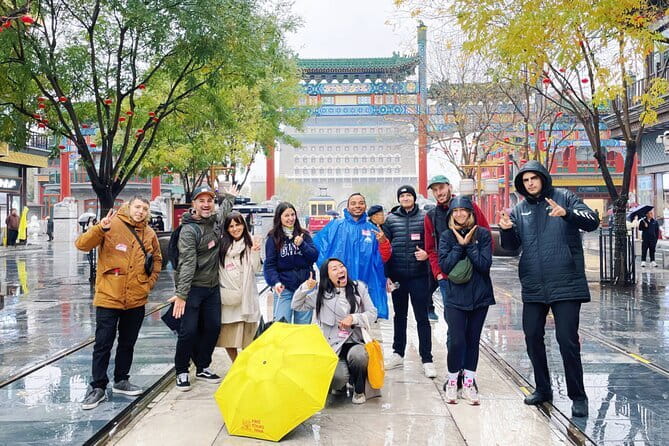
This is a city-orientation walk, not a greatest-hits tour. You will not spend the morning inside the Forbidden City or crossing Tiananmen Square. Instead, you follow the older commercial and residential streets south of central Beijing, where the city’s imperial past meets shops, cafés, markets, and local food stalls.
That choice gives the tour its value. Beijing can feel enormous and hard to read at street level. A guide helps connect the narrow lanes, restored shopping streets, old guild buildings, and modern businesses into one story. You get a sense of how the capital was planned, how neighborhoods changed, and how older traditions still appear in ordinary streets.
The walk begins at 10:00 a.m. at Huguang Guild Hall and finishes at Zhengyangmen, near Qianmen Metro Station. The route includes six stops, with about three and a half hours on foot. You should expect a steady walking morning rather than a series of long indoor visits.
The tour is offered in English with a local guide. Guides named Kris and Hao have been praised for clear explanations, patience, and the ability to keep the group engaged in cold weather. Their approach appears to mix formal history with anecdotes, food, drinks, and small details about Chinese life. That is useful in Beijing, where a short story about a street or shop can explain more than a long list of dates.
A few more Beijing trips to weigh up
- Beijing Historical Tour II including Summer Palace, Lama Temple & Panda Garden
★ 4.0 · 187 reviews - Beijing Historical Tour I – Forbidden City, Tiananmen Square & Temple of Heaven
★ 4.0 · 120 reviews - Beijing Culture: Tea Ceremony, Heritage Instrument & Calligraphy
★ 5.0 · 57 reviews
Huguang Guild Hall and the first chapter of Beijing’s story
The first stop is Huguang Guild Hall, built in 1807. Guild halls served people from the same region, and this one was connected with merchants and officials from Hubei and Hunan provinces. Its opera stage is a key feature, with decorative work that helps you picture the social life once held inside the building.
You spend about 20 minutes here. That is enough time for an introduction and a look at the site, but not a full museum visit. Admission is listed as free, so this opening stop sets the tone without adding another ticket cost.
I like starting here because it gives the walk a clear point in time. You begin with a formal building tied to regional networks, then move into the lanes and shopping streets where Beijing life is easier to observe at close range. The contrast helps you understand that the city was never only an imperial court. It was also a place of trade, migration, entertainment, and local associations.
One hour in the hutongs
The longest section is the hutong walk, at about one hour. These narrow lanes are made up of traditional residential areas and older courtyard homes. The exact streets can vary, but the point is to see Beijing away from its broad avenues and major squares.
This is the part I would value most if you have limited time in the city. The hutongs show how people lived in compact neighborhoods, how entrances and alleys shape privacy, and how older homes now sit beside newer businesses. You may also see small shops, local activity, and food sellers along the way.
A hutong walk demands some flexibility. These are working neighborhoods, not a perfectly staged open-air museum. Some parts may look worn, while other sections have been restored or adapted for new uses. That mix is useful, but people expecting a polished attraction at every corner may find the experience less predictable.
One previous participant expected the major sights, including Tiananmen Square, and instead found the hutong section a welcome lesson in another side of Beijing. That is a fair description of the tour’s purpose. You book this walk for context and street life, not for checking off the city’s most famous monuments.
Liulichang, calligraphy, and Beijing’s old arts
Liulichang Street takes about 40 minutes and brings the walk into one of Beijing’s best-known areas for antiques, calligraphy, traditional painting, and cultural shops. The street has long been linked with literary and artistic life, and its businesses offer a different view of the city from the residential lanes.
This is also the point most closely linked with the calligraphy element in the tour title. The supplied details describe calligraphy creation, but they do not explain the exact workshop format, materials, or whether every departure includes a completed piece to take home. I would confirm those details before booking if making calligraphy is important to you.
Even without a formal class, Liulichang is a useful place to learn how Chinese writing functions as art. Your guide can explain what you are seeing, point out traditional styles, and help you make sense of shops that might otherwise seem difficult to approach. Take care with purchases, since the street includes items at many price levels and the tour does not state that shopping is included.
The 40-minute stop should feel more relaxed than the hutong section. It gives you time to look, ask questions, and enjoy the change from residential lanes to a street built around culture and commerce.
Same country, a completely different kind of day:
- From Beijing: Mutianyu Great Wall Tours with Options
★ 4.9 · 9,216 reviews - Beijing: Forbidden City Tour(Group/Private)-Tickets Included
★ 4.8 · 7,974 reviews - Beijing: T-Square & Forbidden City Group or Private Tour
★ 4.8 · 4,446 reviews - Beijing: Mutianyu Great Wall Daily Tour with Ticket & Lunch
★ 5.0 · 3,056 reviews
Yangmeizhu Byway and a newer side of old Beijing
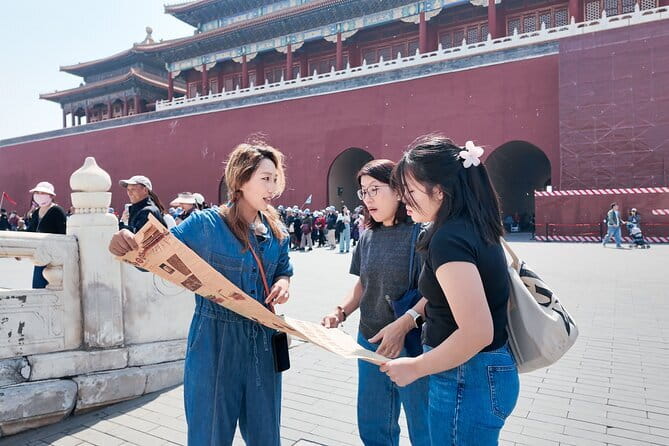
Yangmeizhu Byway receives about 20 minutes. This lane is described as a place where older Beijing meets newer creative businesses, including boutique shops, art studios, and cafés.
The stop matters because it prevents the tour from becoming a simple march through the past. Beijing’s older districts are changing, and streets like this show how traditional buildings can be reused for design, food, and small businesses. You get a quick look at the city’s urban pressures and its attempts to give older areas a new purpose.
Twenty minutes is brief, so think of this as a snapshot rather than a full neighborhood visit. You may have time to hear the guide’s explanation and glance at several storefronts, but not to settle in at a café or browse every shop. If you enjoy contemporary design, you may wish to return later on your own.
Dashilan Street and the taste of commercial Beijing
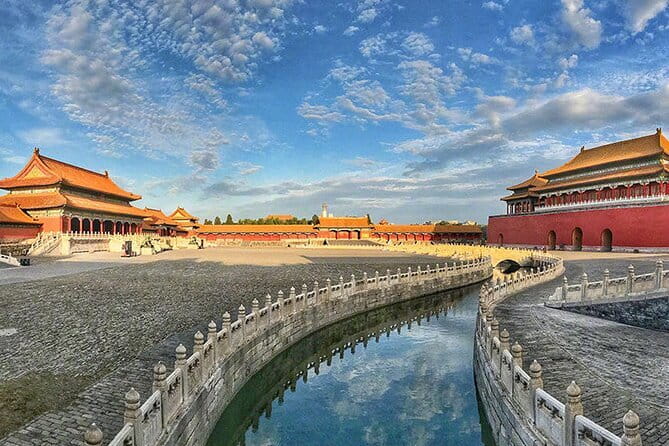
Dashilan Street is another 20-minute stop. It is one of Beijing’s oldest commercial areas and is known for traditional shops, newer retail, and local food. The pedestrian setting makes it easy to focus on the street scene without dealing with ordinary traffic.
Food is one of the pleasant extras here and elsewhere on the route. Specific tastings are not guaranteed in the tour details, but guides have included street-food and drink sampling. If you have dietary restrictions, ask your guide before accepting anything, since no food menu or allergy policy is provided.
Dashilan can be crowded and commercial. That is part of its appeal, but it also means the experience may feel less quiet than the hutongs. I like the stop as a bridge between old trade traditions and modern shopping. It gives you a chance to see how historic names and businesses remain part of Beijing’s public life.
Qianmen Walking Street and the end near Tiananmen
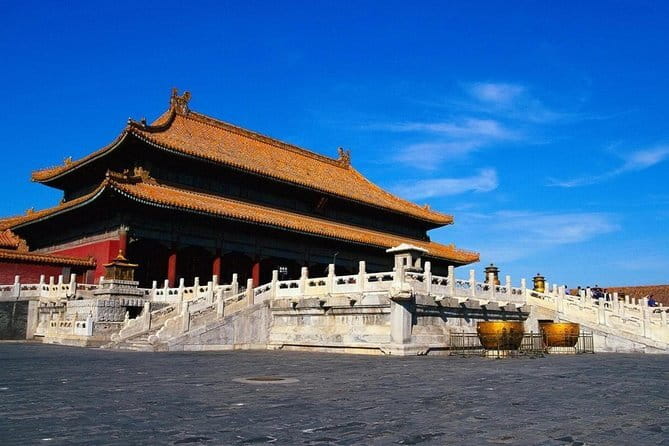
The final stop is Qianmen Walking Street, also for about 20 minutes. Qianmen lies south of Tiananmen Square and is one of Beijing’s best-known shopping and dining areas. The street has restored historic architecture, established commercial names, food businesses, and a strong tourist presence.
This is a practical ending point. From here, you finish in front of Zhengyangmen, close to Qianmen Metro Station on Lines 2 and 8. You are well placed to continue exploring central Beijing or use the subway for the next part of your day.
You should be clear about one important limit: the tour ends in front of Tiananmen Square but does not enter it. If you want to visit the square, you need to make your own reservation at least one day ahead. Same-day reservations are not possible according to the tour information.
Qianmen is a lively finish, but it is also the least offbeat part of the route. The value comes from seeing how the city presents its past through restored streets and major commercial brands. For quieter lanes and local texture, the hutong section is stronger.
Price, tipping, and what the $5 really means
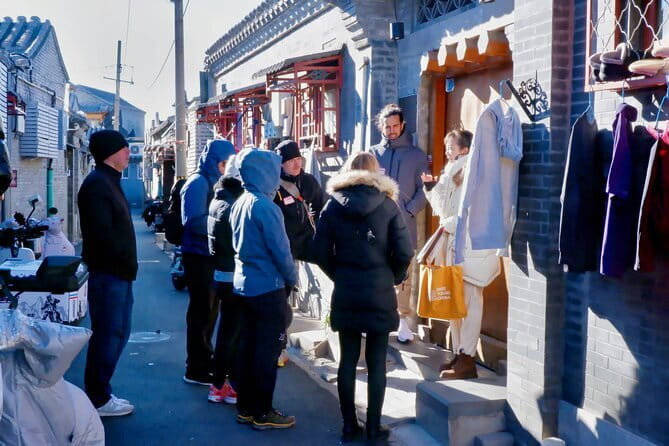
The listed price is $5 per person, but that is not the full expected payment. The operator runs the experience on a tips-based model. The $5 booking fee reserves your place, and the suggested tip is 160 to 200 RMB, described as roughly $20 to $25.
That means you should judge the tour as a low-cost reservation plus a guide gratuity, not as a fully paid $5 excursion. The final amount remains voluntary, but the suggested range is an important part of the budgeting picture. At that total, the tour can offer good value if you want a long guided walk with local explanation, food-related stops, and help understanding Beijing’s neighborhoods.
The value is less clear if you mainly want included admissions, a formal calligraphy lesson, or access to major imperial sights. The listed stops have no admission charge, and Tiananmen Square and the Forbidden City are not part of the route.
The booking information says the shared group is limited to six people per booking, while the additional details give a maximum of 50 participants for the activity. Since those figures do not fully match, ask the provider about the expected group size for your date. A smaller group would make it easier to hear the guide and ask questions in narrow lanes.
Who will enjoy this route most
I would choose this experience if you want to understand Beijing through neighborhoods rather than monuments. It suits first-time visitors who need an introduction to the city’s layout, as well as repeat visitors who have already seen the major imperial sites.
It is also a good fit if you enjoy:
- Walking through older residential lanes
- Learning about daily life and urban change
- Traditional Chinese art and calligraphy
- Food stalls and commercial streets
- A guide who tells stories rather than listing dates
You may want another tour if your priority is Tiananmen Square, the Forbidden City, or a long indoor visit to historic buildings. You should also be comfortable walking for several hours, since the experience is built around moving from one district to the next.
Cold weather can make the route harder, although a guide such as Hao has kept the group moving and engaged during poor conditions. The experience requires good weather and may be rescheduled or refunded if conditions are unsuitable.
Practical details for your morning
The meeting point is Huguang Guild Hall, 3 Hu Fang Lu in Xicheng District. The start time is 10:00 a.m. The end point is Zhengyangmen, W92X+64H, Qianmen Da Jie, near Qianmen Metro Station.
A mobile ticket is accepted, and confirmation is provided at booking. The starting and ending areas are near public transport, which helps if you are staying elsewhere in Beijing.
Wear comfortable shoes and allow time to find Huguang Guild Hall. The route includes hutong lanes and pedestrian streets, so a small bag is easier than bulky luggage. Bring water, and keep some flexibility for food or drink sampling, since the exact offerings can vary.
Free cancellation is available up to 24 hours before the start time for a full refund. Changes made within 24 hours are not accepted, and late cancellations are not refunded. If the minimum number of participants is not reached, or if bad weather cancels the walk, you are offered another date, another experience, or a full refund.
Should you book the Beijing Historic City walk?
Book it if you want a friendly, story-led introduction to southern central Beijing and prefer hutongs, food streets, and cultural shops to a checklist of famous monuments. The strongest parts are the one-hour hutong walk, the useful explanations from guides such as Kris and Hao, and the mix of old neighborhoods with Liulichang’s calligraphy culture and Qianmen’s restored commercial streets.
Go in with clear expectations. The $5 fee is not the whole cost, Tiananmen Square is not included, and the calligraphy creation details need confirmation. If you accept those limits and budget for the suggested tip, this is a practical way to see a more everyday side of Beijing in one well-planned morning.
FAQ
How long does the Beijing Historic City Guided Walking Tour last?
The tour lasts approximately 3 hours and 30 minutes.
What time does the tour start?
The tour starts at 10:00 a.m.
Where does the tour begin?
It begins at Huguang Guild Hall, 3 Hu Fang Lu, Xicheng District, Beijing, China, 100052.
Where does the tour end?
It ends at Zhengyangmen near Qianmen Walking Street and Qianmen Metro Station.
Does the tour enter Tiananmen Square?
No. The walk ends in front of Tiananmen Square but does not enter the square.
Do I need to reserve Tiananmen Square separately?
Yes. You must make your own reservation at least one day in advance. Same-day reservations are not possible.
Is the $5 booking fee the full tour price?
No. The $5 fee reserves your place. The tour uses a tips-based model, with a suggested tip of 160 to 200 RMB, or about $20 to $25.
Is calligraphy included in the experience?
Calligraphy culture is part of the route, especially at Liulichang Street, but the supplied details do not specify the exact format of the calligraphy creation activity. Confirm this with the provider if it is important to you.
Can I cancel for a full refund?
Yes. You can cancel at least 24 hours before the local start time for a full refund. Poor weather or failure to meet the minimum number of participants may also result in another date or a full refund.
Just added around Beijing
- Private Transfer to Mutianyu Great Wall with professional driver★ 5.0 · 19 reviews
- camp on the Great Wall overnight with sunrise and sunset on the wall★ 5.0 · 11 reviews
- One day tour to downtown Tianjin from Beijing by high speed train★ 5.0 · 3 reviews
- BusDa:Ancient Great Wall &Badaling Great Wall Full-day Bus Tour★ 4.5 · 6 reviews
- ZANBUS: Trip to the Jinshanling Great Wall Departing at 7:30 AM★ 5.0 · 5 reviews
- Yuxiandu Chinese Royal Cuisine Museum with Show and Royal Banquet★ 5.0 · 4 reviews
- Private Wild Great Wall Hiking tour at Simatai (Challenging)★ 5.0 · 16 reviews
- Wild Great Wall Huanghuacheng Half Day Tour★ 5.0 · 15 reviews
Walking Tours, compared.

Beijing Hutong Walking Food and Beer Tour at Hidden Restaurants
Read our review →
Private Beijing Walking Tour of the Forbidden City with 7 Options
Read our review →
Dark Side of Hong Kong – Kowloon Caged Homes Walking Tour
Read our review →
Forbidden City Private Walking Tour with Optional Sights
Read our review →
Introduction to Hong Kong: Central Tip Based Walking Tour
Read our review →
Shanghai Highlights Walking Tour With A Real Local
Read our review →Browse the lists this tour appears in