
Reviewed · HISTORICAL TOURS
Between Capitalism & Communism: Hong Kong History Tip Based Tour
Hong Kong’s Central district can look like a wall of glass and money. This two-hour walk shows you the arguments, compromises, beliefs, and personal stories behind it, from the British colonial era to the handover and the politics of One Country, Two Systems. The guide also explains why two banks fought a feng shui battle with buildings and symbols.
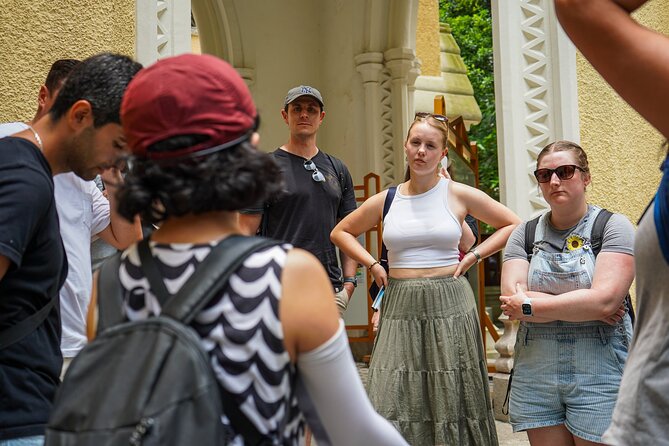
I especially like the way the route joins major civic sights with everyday Hong Kong details, and I like that the guide adds a personal view of recent events rather than giving you only dates and official slogans. Guides including Alice, Andy, Armie, and Wingman have been praised for keeping the talk flowing and making the city easier to understand.
The main drawback is pace. You cover eight stops in about two hours, so some subjects receive only a short explanation. You should also be ready for hills, stairs, city crowds, and a walking route that requires moderate fitness.
Key points at a glance
- Politics in the streets: The Court of Final Appeal and government district give context to Hong Kong’s relationship with China.
- Feng shui meets finance: Statue Square and the HSBC Main Building reveal the symbolic side of the banking district.
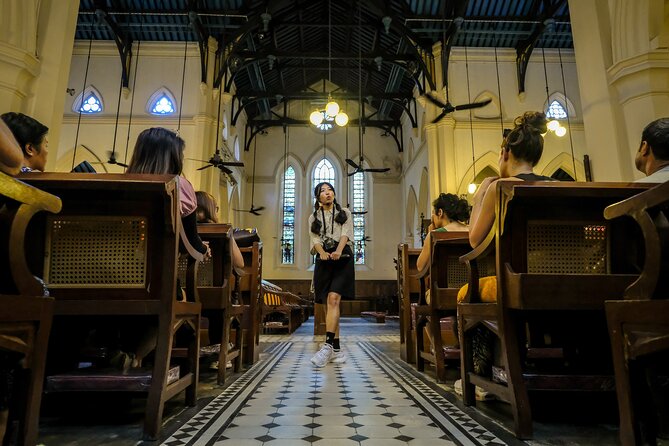
- Colonial history with a human voice: St. John’s Cathedral and Queen’s Road Central connect institutions with daily life.
- A ride up the hillside: The Central-Mid-Levels Escalator helps you understand how Hong Kong deals with its steep terrain.
- Old beliefs, modern law: Hollywood Road and Man Mo Temple show how commerce, religion, art, and justice overlap.
- A useful first-day choice: The tour ends with a local restaurant recommendation and includes a street food tasting.
Why this walk changes the way Central looks
The strongest feature here is not the number of sights. It is the link between them. On your own, you might photograph HSBC, pass St. John’s Cathedral, and ride the escalator without seeing how colonial power, banking, religion, law, and modern politics fit together.
This route gives each place a question. How does Hong Kong practice being part of China? Why did the British build their capital in this part of the city? Why would a bank shape its building around feng shui ideas? What does a colonial church mean in a city now governed under a different political system?
Those questions make the walk useful early in your stay. You leave with more than a list of buildings. You have a framework for reading Central, Admiralty, and Sheung Wan on your own.
The mood is serious at times, especially when the guide discusses colonial rule, the 1997 handover, and current politics. It is not presented as a dry civics lecture, though. Stories about banking symbols, street food, religious practice, and the guide’s own life in Hong Kong keep the subject close to the ground.
The personal angle matters. Alice has been praised for explaining her life in Hong Kong and helping people put the city into perspective. Wingman has also been singled out for sharing a personal story. Andy and Armie are noted for keeping up a steady flow of information. Since the guide is assigned by the operator, you should not assume a particular person will lead your date, but the experience clearly depends on having a strong storyteller.
A few more Hong Kong trips to weigh up
- Coach Tour: Hong Kong Heritage Discovery
★ 5.0 · 4 reviews - Beijing Historical Tour II including Summer Palace, Lama Temple & Panda Garden
★ 4.0 · 187 reviews - Beijing Historical Tour I – Forbidden City, Tiananmen Square & Temple of Heaven
★ 4.0 · 120 reviews
Starting at the Court of Final Appeal
Meet at Central MTR Station, Exit K, at 11:00 a.m. The route begins at the Court of Final Appeal, an apt place to start because law sits at the center of Hong Kong’s political arrangement.
The court is where the idea of One Country, Two Systems faces practical questions. Hong Kong is part of China, yet it has its own legal framework and courts. Your guide explains how that arrangement works in broad terms and why the court matters.
This is a good opening stop because it gives the rest of the walk a clear theme. You are not simply looking at old colonial buildings. You are considering how a former British territory operates after its return to China.
The stop lasts about 10 minutes and admission is free. That time is enough for an introduction, though not enough for a full legal history. If you want detailed discussion of court decisions or constitutional law, you will need to ask focused questions or read further after the walk.
Statue Square and the banking district’s feng shui contest
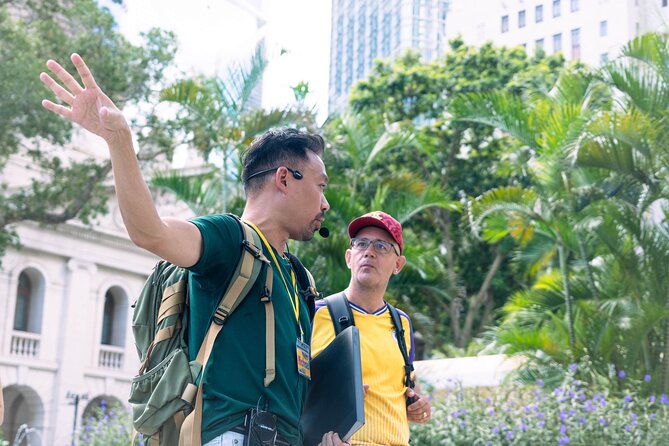
At Statue Square, the guide turns from courts to money. This open civic space is surrounded by the symbols of financial power, and the stories here show how business in Hong Kong can involve both modern finance and traditional belief.
The most entertaining subject is the supposed feng shui battle between major banks. Building shapes, towers, entrances, and symbolic objects are said to affect fortune and competition. The point is not that feng shui replaces banking. It is that Hong Kong’s financial world has long made room for cultural ideas that outsiders may not expect to see beside skyscrapers and trading offices.
You then move to the HSBC Main Building, where the famous guardian lions provide another way to talk about wealth and protection. The guide also uses the building to explain Hong Kong’s financial system, including the fact that no central bank prints money in the traditional sense here.
The stop is brief, about 10 minutes at each location. That works well for a walking tour because you get a memorable story without being trapped in a technical lecture. It also means the treatment is interpretive rather than exhaustive. You will hear why the buildings matter, but you should not expect an architectural tour or an inside visit.
St. John’s Cathedral and the colonial capital
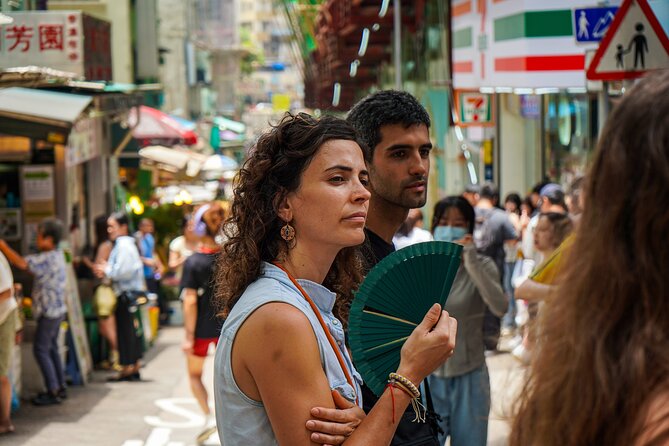
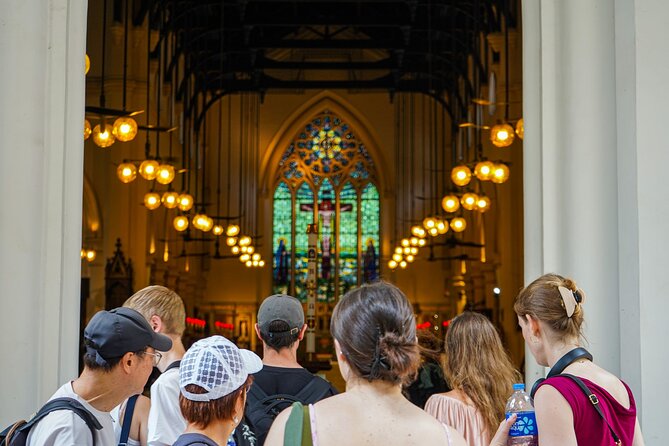
St. John’s Cathedral offers a welcome change from glass towers and traffic. It is Hong Kong’s oldest church, and the 20-minute stop gives the guide more room to explain the colonial period, religious life, and the way British power shaped the city.
The cathedral is especially useful because it puts a human and spiritual setting beside the government and banking institutions you have just seen. The route asks you to consider who held authority in colonial Hong Kong, which communities were served by its institutions, and how those institutions remain visible today.
The guide also connects the church to a personal story. That detail helps keep the discussion from becoming a museum label read aloud. You get a sense of how major historical shifts still affect people who live in Hong Kong now.
This is the longest stop on the first half of the route, but it is still only about 20 minutes. If the church is closed or a service is taking place, the exact experience may depend on conditions at the time. The supplied information does not promise an interior visit, so think of this as a contextual stop rather than a guaranteed church tour.
Same country, a completely different kind of day:
- Hong Kong: Dolphin Cruise, Big Buddha & Lantau Island Tour
★ 4.2 · 1,512 reviews - Ngong Ping 360: Cable Car Return Tickets & Combos
★ 4.6 · 1,431 reviews - Lantau Island Day Trip – Big Buddha & Tai O
★ 4.5 · 1,328 reviews - Big Bus Hong Kong Open Top Hop-On Hop-Off Sightseeing Tour
★ 4.0 · 1,077 reviews
Queen’s Road Central and Hong Kong’s working rhythm
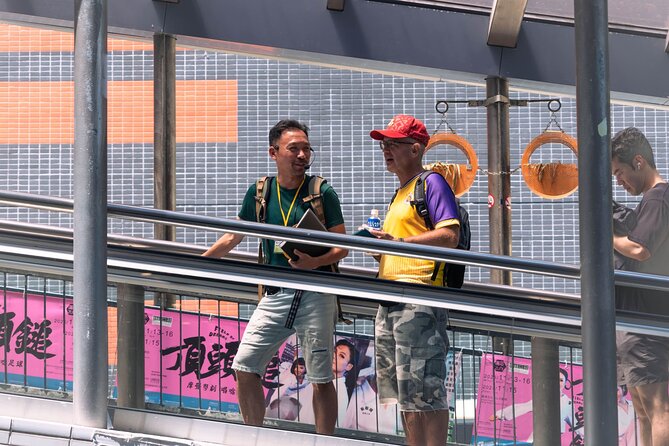
Queen’s Road Central brings you back into the present. The setting is all office towers, expensive commercial space, power suits, and constant movement. The guide uses the road to describe the pressure that defines modern Hong Kong: high rents, limited land, and a city that keeps pushing outward and upward.
This is one of the best places to connect history with ordinary observation. You can see the financial district not as an abstract center of global business, but as a place where people work, shop, commute, and compete for space.
The tour’s language about the city growing into the sea fits here. Hong Kong’s built environment has been shaped by the need to create more usable ground, while the hills leave little room for easy expansion. The guide also explains why the British chose to develop their capital amid the hills, giving you a clearer sense of the city’s original strategic and physical setting.
The stop lasts roughly 10 minutes. Expect a roadside explanation rather than a long pause. Wear comfortable shoes and stay alert while moving through Central. The route is designed to keep going.
Riding the 800-meter Mid-Levels Escalator
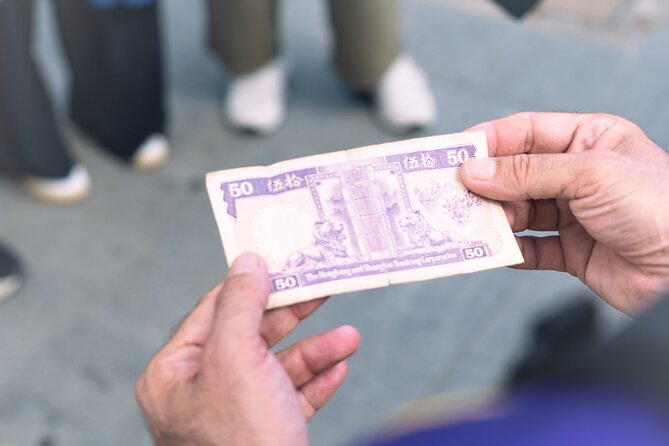
The Central-Mid-Levels Escalator is the route’s most practical attraction. At about 800 meters, it is described as the world’s longest outdoor escalator, and it solves a very Hong Kong problem: how to move people across steep hills without asking everyone to climb.
You ride rather than simply look at it, which gives the stop a welcome change of pace. The escalator is also a piece of daily infrastructure, not a monument built only for sightseeing. As you move uphill, the city’s vertical shape becomes easier to understand.
The guide presents it as an engineering answer to Hong Kong’s killer hills. That phrase captures the point without requiring a technical lecture. The city’s slopes influence where people live, how streets are laid out, and how neighborhoods connect.
The scheduled stop is about 10 minutes, so you will not spend the whole route riding upward. The escalator is part of a public transport system, and its operating direction can vary by time of day. The tour information does not promise a particular direction or a full-length ride, so treat this as a short experience within the walk.
Hollywood Road from colonial divide to creative district
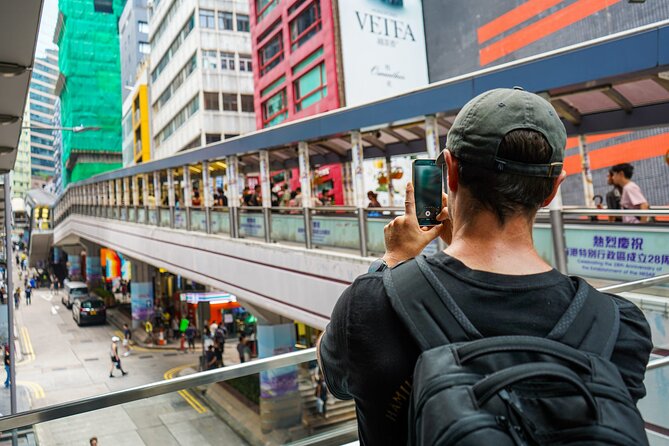
Hollywood Road shows another side of Central and Sheung Wan. The guide describes its shift from a colonial dividing line to a district associated with art, food, and street life.
That change is important because Hong Kong’s past is not frozen in official buildings. Old streets can take on new uses, and neighborhoods shaped by colonial boundaries can become places for creative businesses and informal city life.
This section should appeal to anyone who wants more than finance and politics. You get a chance to see how cultural activity fits into the older urban fabric. The stop is still short, about 10 minutes, so the guide cannot provide a full gallery guide or a detailed food crawl. Instead, you get a quick reading of the area and suggestions for what to notice after the tour.
The route’s street food tasting belongs to this wider move toward everyday culture. The exact food is not specified, so do not book this expecting a particular dish. Think of it as a small local taste included in a history walk.
Man Mo Temple and the final link between belief and law
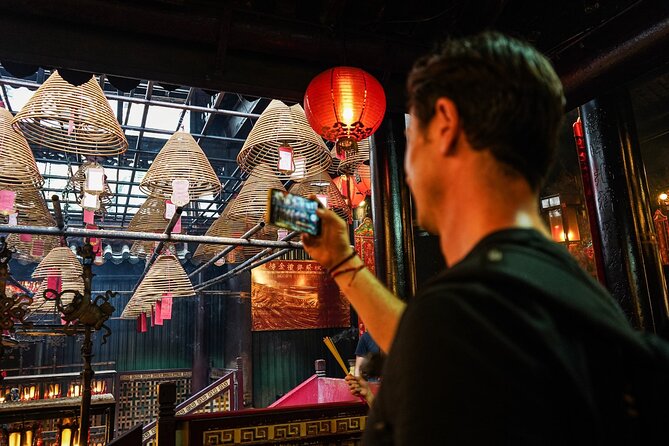
The walk ends at Man Mo Temple, at 124 to 130 Hollywood Road in Sheung Wan. This is a fitting finish because the temple brings together scholarship, worship, public life, and justice.
The guide explains how ancient gods witnessed the city’s legal evolution. That idea gives the final stop a strong contrast with the Court of Final Appeal at the beginning. You start by asking how law works under Hong Kong’s present political system, then finish with an older spiritual setting that reflects earlier ideas about morality, authority, and public order.
Man Mo Temple also leaves you in a useful neighborhood for the rest of your day. The tour ends here rather than returning you to Central, and the guide provides recommendations for a local restaurant lunch. That advice can be worth as much as the short food tasting, especially if you want to continue exploring on foot.
The endpoint is not a hotel or transit station. You can reach it through nearby public transportation, but hotel pickup and drop-off are not included. Plan your next move before you arrive.
How much value do you get for $2.63?
At the stated price of $2.63 per person, this is an unusually inexpensive way to spend two hours in Hong Kong. The value comes from the guide’s interpretation, not from paid admissions. Every listed stop has free admission, and the route is a walking experience with a small street food tasting.
That low price makes the tour easy to recommend as an orientation walk. You see the financial district, a colonial church, a major road, the escalator, Hollywood Road, and Man Mo Temple in one compact outing. You also receive restaurant suggestions for lunch.
The tradeoff is depth. Eight stops in about two hours means the guide must keep moving. You will get short explanations at most locations, with St. John’s Cathedral receiving the longest scheduled visit. If you want long museum visits, private conversation, or a slow photographic walk, this is not the right format.
The group can have up to 30 people. That is not a tiny private walk, and a larger group may make questions or street crossings less personal. On the other hand, the route is structured and short, so the group size is less serious than it would be on an all-day excursion.
A 4.9 rating from 234 ratings and a 97 percent recommendation figure suggest that the format is working well for its intended purpose. The repeated strengths are the guide’s personal touch, a steady stream of information, and the way the walk helps you understand the changing city. Those are precisely the qualities you should value here.
Who will get the most from this experience?
I would choose this tour for a first visit, especially if you want to understand Hong Kong before spending time in Central, Admiralty, Sheung Wan, or the Mid-Levels. It is also a good fit if current politics and the 1997 handover interest you but you prefer stories tied to real streets and buildings.
You should have moderate physical fitness. The route involves walking through dense urban areas and dealing with Hong Kong’s hills. Comfortable shoes are more important than formal clothing, and you should be ready to keep pace.
This is less suitable for someone who wants a fully private discussion of politics or a slow architectural study. The $2.63 price is attractive, but it comes with a compact schedule and a group that may reach 30 people.
The mobile ticket makes arrival simple. Confirmation is provided at booking, and the meeting point is near public transportation. The activity requires good weather and a minimum number of participants. If weather or numbers force cancellation, you are offered another date or experience, or a full refund.
For cancellation, you can receive a full refund if you cancel at least 24 hours before the 11:00 a.m. start. Changes or cancellations inside that 24-hour window are not accepted for a refund.
Should you book this Hong Kong history walk?
Book it if you want a low-cost, high-context introduction to Central and Sheung Wan. The best reason to go is the guide’s ability to connect courts, banks, churches, roads, hills, temples, and recent politics into one story. Personal accounts from guides such as Alice, Wingman, Andy, and Armie add a human scale that a self-guided route may lack.
Skip it if you want a quiet walk, a private guide, or extended time inside each building. You will be moving often, and the political discussion may leave you wanting more time and detail.
For most first-time visitors, I would book it near the start of a Hong Kong stay. The route gives you useful bearings, a few memorable explanations, a taste of local food, and a practical suggestion for lunch. At $2.63, it is a small gamble with a clear payoff: you will see Central with sharper eyes for the rest of your visit.
FAQ
How long is the Hong Kong history tour?
The experience lasts approximately two hours.
Where does the tour start?
It starts at Central MTR Station, Exit K, in Central, Hong Kong.
What time does the tour begin?
The scheduled start time is 11:00 a.m.
Where does the tour end?
The walk ends at Man Mo Temple, 124 to 130 Hollywood Road, Sheung Wan, Hong Kong.
Is food included?
Yes. A street food tasting is included, and the guide provides recommendations for a local restaurant lunch.
Is hotel pickup or drop-off included?
No. Hotel pickup and drop-off are not included.
What happens if the tour is canceled because of weather or low participation?
You will be offered a different date or experience, or a full refund.
Just added around Hong Kong
- Hong Kong Airport to Hong Kong City Private Arrival Transfer★ 4.5 · 3 reviews
- Hong Kong Observation Wheel Ticket★ 5.0 · 3 reviews
- Hong Kong Palace Museum Ticket★ 5.0 · 3 reviews
- Hong Kong Peak Tram and Sky Terrace 428 Tickets (Optional)★ 3.5 · 22 reviews
- Hong Kong Private Walking Tour with a Local★ 5.0 · 6 reviews
- Hong Kong Market Walking Tour & Chinese Cooking Class★ 5.0 · 24 reviews
- Hong Kong : Must-See Attractions Walking Tour With A Guide★ 5.0 · 7 reviews
- Hong Kong: Lantau Island & Tai O Cruise, Skip The Line Cable Car★ 3.5 · 4 reviews
Historical Tours, compared.
Beijing Historical Tour II including Summer Palace, Lama Temple & Panda Garden
Read our review →
Beijing Historical Tour I – Forbidden City, Tiananmen Square & Temple of Heaven
Read our review →
Tour of Jewish Shanghai led by a Jewish History Expert
Read our review →
Beijing Historic City Guided Walking Tour + Calligraphy Creation
Read our review →
Beijing Culture: Tea Ceremony, Heritage Instrument & Calligraphy
Read our review →
2-Hour Beijing Private Forbidden City Tour: History & Highlights
Read our review →
Xi’an Full Day Sightseeing Tour – Shaanxi History Museum, Big Wild Goose Pagoda, Ancient City Wall
Read our review →
Private Historical Tour: Guangzhou City Sightseeing Including Lunch
Read our review →Browse the lists this tour appears in