
Reviewed · BEIJING TOURS
Beijing Tai Chi and Tea Ceremony Experience
Tai Chi and tea are not treated as two unrelated activities here. Eric uses the morning lesson to explain how Taoist ideas shape Tai Chi, then Alice carries the theme into a calm tea session with tasting, ceremony, and quiet attention. It is a thoughtful way to meet Chinese culture through the body and the senses.
I like the private format, since Eric can adjust the lesson to your experience level instead of forcing every person into the same routine. I also like the clear handoff from Tai Chi to tea, with four or five Chinese teas, three to five snacks, and a chance to learn how tea quality is judged.
The main consideration is time. The Tai Chi lesson lasts about one hour inside a three-hour activity, so this is an introduction rather than serious martial arts training. You also meet at Jixiaolan Former Residence at 9:00 a.m., and comfortable walking shoes are a smart choice.
Key points to know before booking
- Eric teaches the one-hour Tai Chi session: You learn basic relaxation forms, typical movements, Taoist ideas, and simple self-massage in English.
- The lesson suits beginners: Eric checks your experience level and adjusts the class, so you do not need prior Tai Chi training.
- Alice leads the tea portion: You taste four to five types of Chinese tea and learn about tea culture and Kungfu tea preparation.
- The activity is private: Only your group takes part, which gives you more room to ask questions and work at your own pace.
- The meeting point is central Beijing: Start at Jixiaolan Former Residence in the Qianmen area at 9:00 a.m., near public transportation.
- The experience lasts about three hours: Tea and snacks are included, but this is not meant to replace a full meal.
Starting with Taoist ideas and slow movement
The most interesting part of this experience is its cultural frame. Tai Chi is presented not simply as gentle exercise, but as a practice connected to Taoism, relaxation, breath, and the movement of Qi through the body.
You should treat this as an introduction to a traditional way of thinking, not as a medical treatment. The class explains why Tai Chi has become popular around the world and how its slow movements are linked with balance, calm, and body awareness.
Eric leads the Tai Chi section in English. His teaching begins with basic relaxation work before moving into typical Tai Chi forms. That order matters. If you have never tried Tai Chi, the slow pace can feel unusual at first. Starting with relaxation gives you a better chance to notice posture, breathing, and the way each movement connects to the next.
You also learn simple self-massage methods. These are practical additions to the class because they give you something you can remember after leaving Beijing. Do not expect a long list of complicated techniques. The value is in learning a few basic ideas and seeing how Tai Chi fits into daily health and self-care.
Other Beijing days worth booking alongside this:
- From Beijing: Mutianyu Great Wall Tours with Options
★ 4.9 · 9,216 reviews - Beijing: Forbidden City Tour(Group/Private)-Tickets Included
★ 4.8 · 7,974 reviews - Beijing: T-Square & Forbidden City Group or Private Tour
★ 4.8 · 4,446 reviews
Why the private class helps beginners
A private activity changes the mood of a lesson. You are not trying to keep up with a large class, and Eric can ask about your experience before organizing the session. That makes this a good choice if you are a complete beginner, unsure about balance, or simply curious but not ready for a formal martial arts school.
The available feedback points to Eric’s patience and clear instruction as major strengths. One participant described arriving with no previous experience and receiving a lesson shaped around that starting point. Another found the practice both relaxing and enjoyable, with attention placed on the mind, eyes, and body.
Those details give you a useful picture of the class. It is not built around speed, competition, or athletic performance. You will likely spend more time learning how to pay attention than trying to memorize a long sequence of movements.
The private setting also works well for mixed groups. If one person has tried Tai Chi before and another has not, Eric can adjust the pace. Group discounts are available, although the exact discount depends on the booking arrangement.
Meeting at Jixiaolan Former Residence
The activity starts at Jixiaolan Former Residence, listed in the Qianmen area of Xicheng District, Beijing. The start time is 9:00 a.m., so plan your morning carefully and allow enough time to reach the meeting point.
The location is near public transportation, but private transportation is not included. You arrange your own way to the start and return to the same meeting point at the end. A mobile ticket is available, and confirmation is sent at the time of booking.
Wear comfortable walking shoes. Even though Tai Chi itself is slow and gentle, you may spend time moving between the meeting point and the tea house, and firm shoes make the morning easier.
The early start is part of the appeal. Tai Chi fits naturally into the morning, before a full day of sightseeing. It also gives you a quiet activity before the noise and crowds that can come with Beijing’s major sights. Still, a 9:00 a.m. meeting means this is not a late-start option for people who prefer slow hotel mornings.
From basic forms to self-massage
The one-hour Tai Chi lesson covers several connected subjects:
- Taoist ideas behind Tai Chi
- Relaxation forms
- Basic Tai Chi movements
- Simple self-massage
- The reasons Tai Chi is practiced around the world
- Ways the practice is linked with health and balance
The lesson is best understood as a cultural workshop with movement, rather than a full technical course. You learn what the practice is trying to achieve, then experience a few of its basic methods.
The language used to describe the class focuses on Qi, harmony between people and nature, and improved awareness. These ideas are central to the presentation, but you should keep your expectations realistic. One hour is enough to gain a feel for the practice and learn a few foundations. It is not enough to master a complete Tai Chi routine or assess long-term health results.
I like that the class includes both explanation and action. A talk about Taoism alone could feel abstract, while movement without context might seem like a series of slow gestures. Here, the two parts are meant to support each other.
If your main goal is exercise, you may find the session too short. If your goal is to understand why Tai Chi holds such an important place in Chinese culture, the format makes more sense.
Same country, a completely different kind of day:
- Beijing: Mutianyu Great Wall Daily Tour with Ticket & Lunch
★ 5.0 · 3,056 reviews - All-Inclusive Tour: Tiananmen Square, Forbidden City, Great Wall
★ 5.0 · 2,873 reviews - MuBus: Mutianyu Great Wall ENG/ESP/RUS Guided Bus Tour
★ 5.0 · 2,361 reviews - 4-Hour Small Group Tour to Forbidden City with Entry Tickets
★ 5.0 · 1,863 reviews
Alice’s tea table and four or five Chinese teas
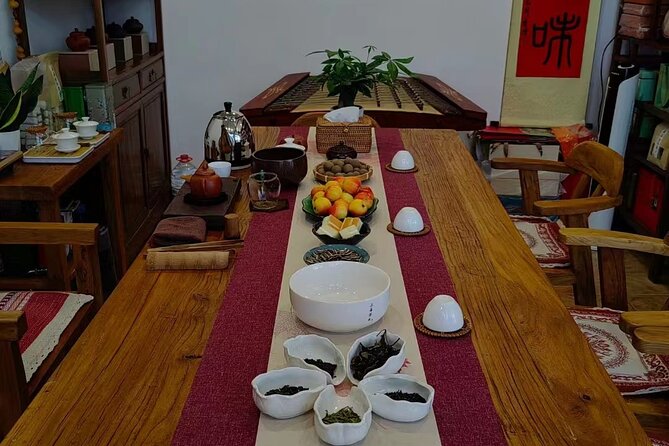
After Tai Chi, the experience moves to a tea house led by Alice. The tea section gives you a chance to taste four to five different Chinese teas, compare them, and learn how quality can be judged.
This is more useful than simply being handed a cup and told what you are drinking. Alice teaches you how to notice differences for yourself. You may find that the same basic tea can seem very different depending on aroma, flavor, preparation, and the way it feels as you drink it.
The tea portion also explains the place of tea in Chinese life and Taoist practice. Tea is presented as a daily drink, but also as a tool for calm, reflection, and steady attention. That connects neatly with the Tai Chi lesson. Both activities ask you to slow down and notice what your body and mind are doing.
Three to five snacks are included with the tasting. They should make the tea session more comfortable, but do not plan on this as a full breakfast or lunch. Food is listed separately from the included coffee or tea, so anyone wanting a substantial meal should make other plans.
Learning Kungfu tea ceremony
The Kungfu tea ceremony is one of the most distinctive parts of the morning. In this context, Kungfu refers to the careful skill and method used in preparing tea, not a martial arts demonstration.
Alice shows you how tea is prepared and served, and explains the customs connected with the process. The ceremony gives structure to the tasting. You are not just sampling several drinks in quick succession. You are watching how the tea is handled, smelling it, tasting it, and considering how preparation affects the final cup.
The tea ceremony also provides a quiet pause after the movement class. The morning shifts from body awareness to sensory attention. That makes the pairing feel deliberate rather than like two random activities placed together.
The tea house section received particularly strong praise for its explanation of tea history, culture, and science. If you enjoy food traditions, craft, or small details of daily life, this may be the portion you remember most clearly.
Do keep the format in perspective. This is an educational tasting, not a meal and not necessarily a shopping trip. The information provided does not promise tea purchases, a market visit, or a lengthy tea ceremony with formal costumes.
How the two halves work together
Many Beijing activities pack several unrelated stops into one morning. This one has a clear idea running through it: relaxation, attention, and Taoist culture.
Tai Chi gives you a physical way to explore those ideas. Tea gives you a seated, sensory way to continue them. The change of pace is welcome. You are active at first, then settle down with a cup and a snack.
I also like the contrast between the two instructors. Eric handles movement and the philosophical background. Alice takes over for tea preparation and tasting. The people who lead each half have different roles, and that helps prevent the experience from feeling like one long lecture.
The reviews of the activity repeatedly praise both instructors by name. Eric is described as kind, patient, and humble, while Alice is praised for her warm manner and strong tea presentation. Those personal qualities matter in an activity that depends on close instruction and conversation.
Since the activity is private, you have a better chance to ask basic questions without feeling self-conscious. You can ask Eric to repeat a movement or ask Alice to compare two teas. That level of interaction is harder to guarantee in a large group.
Is $95 a fair price?
At $95 per person, this is not a bargain-priced exercise class or a simple tea tasting. The value depends on what you want from a three-hour private experience.
You are paying for two instructors, a private format, an English-language lesson, tea tasting, snacks, and the cultural explanation linking Tai Chi with Taoism and Chinese tea. For a couple, family, or small group that wants personal instruction, the price can make sense.
The cost is harder to justify if you only want to try Tai Chi for a few minutes or drink one cup of tea. You could likely find cheaper ways to sample either activity separately. The strength here is the combination and the attention from the instructors.
Group discounts may improve the value for larger bookings. Since the activity is private, you are not sharing the session with unrelated participants. That can be especially useful if your group includes older family members, complete beginners, or people who want to ask many questions.
Remember that private transportation and food are not included. Tea and snacks are part of the experience, but you should budget separately for getting to the meeting point and for any meal you want afterward.
Who will enjoy this Beijing experience?
I would recommend this activity to you if you want a calm cultural morning rather than a packed sightseeing schedule. It suits people who are interested in:
- Chinese philosophy and Taoist ideas
- Gentle exercise
- Tea preparation and tasting
- Small-group or private instruction
- Cultural activities led in English
- A first introduction to Tai Chi
- A quiet start to a day in Beijing
It is also a good fit for couples, families, and friends who want an activity they can share without needing a high level of fitness.
You may want to choose something else if you are looking for advanced Tai Chi training, a full martial arts lesson, a large historical tour, or a substantial food experience. The class is introductory, the tea snacks are limited, and the focus is on learning and reflection rather than sightseeing.
The activity can also work well for someone who feels unsure about trying Tai Chi in a public park. You receive an organized introduction from an English-speaking master, with a chance to ask questions and work through the basic forms in a private setting.
Timing, cancellation, and practical details
The full experience lasts about three hours and begins at 9:00 a.m. It ends back at the meeting point. Confirmation is provided when you book, and the mobile ticket makes it easier to keep the reservation details with you.
Free cancellation is available if you cancel at least 24 hours before the local start time. Cancellations made inside that window are not refunded, and changes are not accepted during the final 24 hours.
Bring water if you usually need it during morning activities, although water is not listed as an included item. Most important, arrive ready to move slowly and pay attention. The lesson is not demanding in the way a workout is, but you will get more from it if you do not rush through the movements.
Should you book the Tai Chi and tea morning?
Book it if you want a personal introduction to two parts of Chinese culture that are often reduced to quick photo opportunities. Eric’s beginner-friendly Tai Chi lesson and Alice’s detailed tea session give the morning a human scale, with time to ask questions and learn by doing.
The $95 price is reasonable for a private three-hour activity with two instructors, but it is not the right choice for everyone. You are paying for cultural context, personal attention, and a carefully paired experience, not advanced training or a full meal.
For a first visit to Beijing, I like this as a gentle morning option. Wear comfortable shoes, eat according to your plans, meet Eric at 9:00 a.m., and expect an introduction rather than mastery. If that sounds like the kind of cultural experience you want, this is a strong choice.
FAQ
Where does the Tai Chi and tea experience begin?
It begins at Jixiaolan Former Residence, Ji Xiao Lan Gu Ju, in the Qianmen area of Xicheng District, Beijing, China, 100052.
What time does the activity start?
The start time is 9:00 a.m.
How long does the experience last?
The activity lasts approximately three hours.
Is the experience private?
Yes. Only your group participates in the activity.
What is included in the price?
The experience includes coffee and/or tea, all fees and taxes, the Tai Chi lesson, tea tasting, and the listed tea snacks.
Can I cancel for a full refund?
Yes, if you cancel at least 24 hours before the local start time. Cancellations made less than 24 hours before the start are not refunded.
Just added around Beijing
- Private Transfer to Mutianyu Great Wall with professional driver★ 5.0 · 19 reviews
- camp on the Great Wall overnight with sunrise and sunset on the wall★ 5.0 · 11 reviews
- One day tour to downtown Tianjin from Beijing by high speed train★ 5.0 · 3 reviews
- BusDa:Ancient Great Wall &Badaling Great Wall Full-day Bus Tour★ 4.5 · 6 reviews
- ZANBUS: Trip to the Jinshanling Great Wall Departing at 7:30 AM★ 5.0 · 5 reviews
- Yuxiandu Chinese Royal Cuisine Museum with Show and Royal Banquet★ 5.0 · 4 reviews
- Private Wild Great Wall Hiking tour at Simatai (Challenging)★ 5.0 · 16 reviews
- Wild Great Wall Huanghuacheng Half Day Tour★ 5.0 · 15 reviews
Beijing Tours, compared.


Forbidden City Tour(Group/Private)-Tickets Included
Read our review →
Mutianyu Great Wall Daily Tour with Ticket & Lunch
Read our review →
All-Inclusive Tour: Tiananmen Square, Forbidden City, Great Wall
Read our review →
4-Hour Small Group Tour to Forbidden City with Entry Tickets
Read our review →

Tianmen Square, Forbidden City & Royal Museum Tours
Read our review →