
Reviewed · EVENING EXPERIENCES
2-Hour “Ancient & Modern” Beijing Sidecar Tour (Day /Night)
Beijing comes into focus fast from the back of a motorcycle sidecar. In two hours, you move from quiet hutong lanes and old city landmarks to Houhai, the Forbidden City moat, Workers’ Stadium, and the sharp-edged towers of the CBD. It is a clever way to connect parts of the city that feel worlds apart.
I like the close-up view of ordinary Beijing life, and I like the number of photo stops packed into a short ride. Guide John has also been punctual with hotel pickup and flexible about the final drop-off, details that can make a short city tour much easier. The drawback is simple: two hours is enough for an introduction, not a full visit to any major sight, and motorcycle travel depends on good weather.
Key points to know before you book
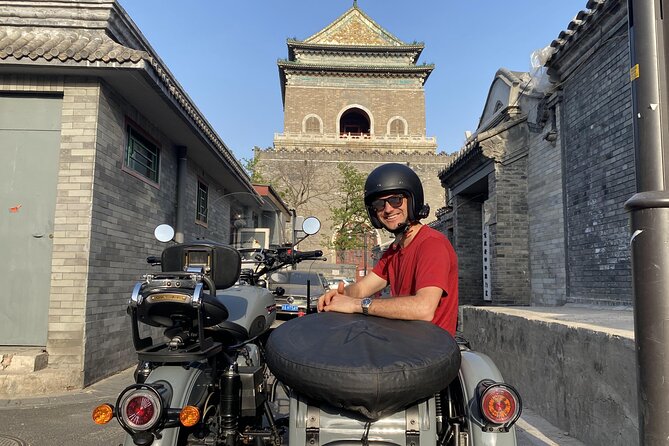
- Old and new Beijing in one ride: Move from hutong alleys and the Bell and Drum Towers to the CCTV building and modern CBD.
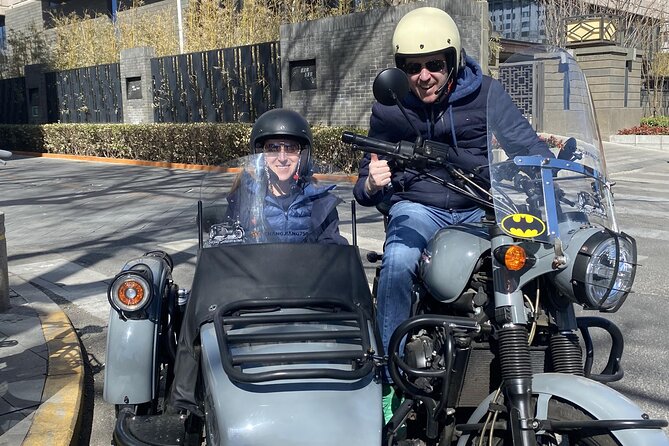
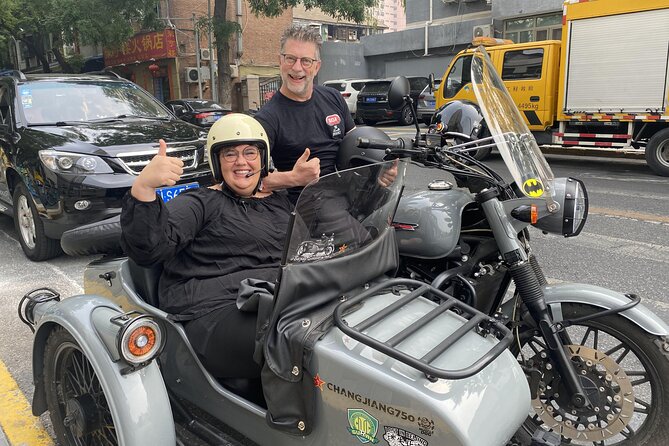
- A private two-passenger sidecar: One person rides in the sidecar and one sits behind the driver, with the option to switch halfway.
- Strong photo-stop design: Houhai, the Forbidden City moat, Workers’ Stadium, and the Ming City Wall Park each offer a different view of the city.
- A practical first-day tour: The route helps you understand Beijing’s central areas before tackling longer sightseeing days.
- Small comforts included: You get helmets, bottled water, snacks, phone charging, raincoats, and seasonal drinks.
- Weather matters: Poor conditions can lead to a new date or a full refund, so keep your plans flexible.
Why a Beijing sidecar ride works so well
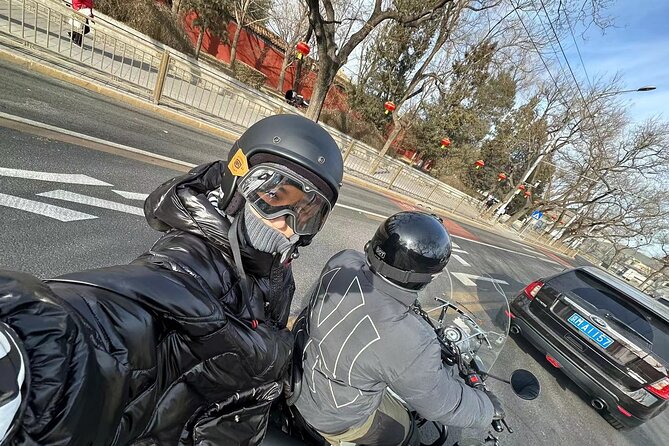
A tour bus gives you a city through glass. A sidecar gives you changing sounds, smells, and street views at eye level, without asking you to walk several miles between scattered sights. You can look into a narrow lane, then turn a corner and see a major road or high-rise office tower.
That contrast is the main point here. Beijing is not one single historical postcard. Its old neighborhoods sit close to new commercial districts, sports venues, lakes, and surviving city walls. The sidecar lets you cover these changes without spending your short visit underground or in traffic.
The route is also built for people who want an overview before choosing where to return. You will not enter the Forbidden City, climb the Bell Tower, or tour the CCTV building. Instead, you see key exteriors and public areas, learn how they fit together, and collect a useful set of first impressions.
At $89 per person, the value depends on what you want from a two-hour outing. It is not the cheapest way to move around Beijing, but it includes a private experience, a professional driver-guide, safety gear, drinks, snacks, and a memorable form of transport. For two people who want something more personal than a standard sightseeing vehicle, the price is easier to justify.
A few more Beijing trips to weigh up
- Great Wall at Gubeikou and Jinshanling Private Sunset Tour
★ 5.0 · 307 reviews - Private Night Sightseeing Tour of Beijing
★ 5.0 · 124 reviews - Beijing: Mutianyu Great Wall Tours–Tickets&Day/Night Options
★ 4.8 · 113 reviews
Starting near the National Art Museum
The listed starting point is the National Art Museum of China at 1 Wu Si Da Jie in Dongcheng District. The tour returns to the same meeting point, although pickup is offered and John has collected people from hotels. Confirm the pickup details when booking, especially if you are relying on a hotel departure rather than going to the museum area.
This location places you near central Beijing, close to the kind of older streets and major landmarks that suit the route. You should arrive ready to ride, with comfortable clothes and shoes, even though you will not be walking continuously.
The sidecar holds two passengers. One person sits in the sidecar, while the other rides behind the driver. You can switch halfway, which matters more than it may sound. The two seats offer different angles and different levels of wind exposure, so sharing them makes the outing fairer.
Helmets are provided. Raincoats are also available, along with bottled water and a phone charging cable. Those are useful touches on a motorcycle, where weather and battery life can affect your comfort and your ability to take pictures.
Hutongs and the Bell and Drum Towers
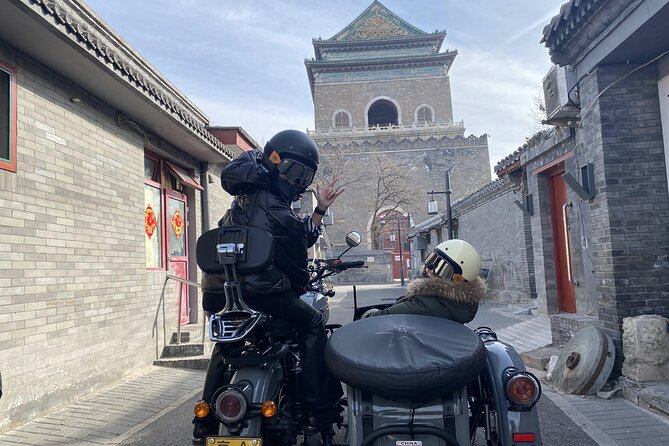
The ride begins in Beijing’s traditional hutong areas, where the city feels more intimate and local than it does around its grand avenues. These narrow lanes offer glimpses of daily life, older housing, and the compact street pattern that shaped central Beijing.
You are not entering a museum version of old Beijing. You are passing through working neighborhoods. That makes the sidecar particularly useful because it can slip into smaller lanes and give you a moving view instead of a quick look from a large vehicle.
The Bell and Drum Towers are the first named stop. They are important buildings on Beijing’s central axis and familiar landmarks for photographs. The stop lasts about five minutes and has no admission charge.
Five minutes is enough for pictures and a quick explanation, but not for an interior visit. Think of this stop as an orientation point. The towers help you understand Beijing’s old north-south planning and give the tour a clear historical anchor before it moves toward the lakes.
If you want a long, detailed look at the towers, you would need to return independently. On this ride, the value is seeing them in context, with the hutongs around them and the motorcycle waiting to carry you onward.
Houhai and Shichahai by the water
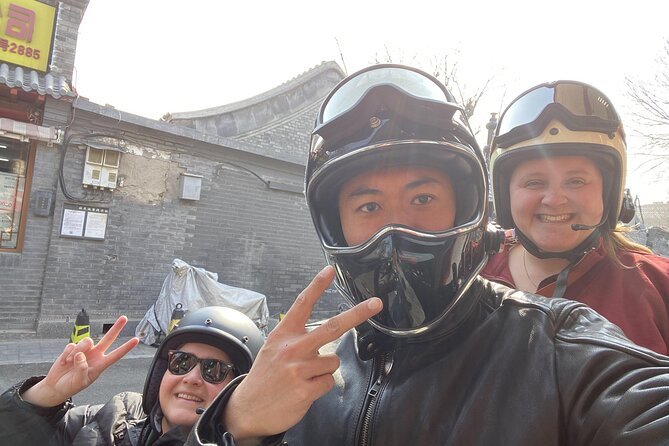
At Shichahai Scenic Resort, the sidecar follows the Houhai lakes. This is one of the more relaxed sections of the outing, with about 15 minutes for views and drinks.
The water provides a welcome change after the tight hutong lanes. You can pause, take pictures, and enjoy the contrast between the lakefront and the surrounding old neighborhoods. The tour includes seasonal refreshments: hot coffee or tea in winter, and cold soda or beer in summer. Beijing special snacks are also included.
The drink service is a small but useful part of the design. You are not racing from one landmark to another with no pause. You get a moment to sit back, cool down, or warm up while the guide points out what you are seeing.
Do note the wording around beer. Since the ride continues on a motorcycle, you should use good judgment and follow local rules. The included seasonal drink is a comfort item, not a reason to treat the stop as a drinking session.
Houhai can be a lively area, especially at popular times, but the supplied route description does not promise a quiet ride or a particular level of activity. Your experience will depend on the time of day and conditions. The night option may give the modern city a different feel, while the day tour can make hutong details easier to see.
Same country, a completely different kind of day:
- From Beijing: Mutianyu Great Wall Tours with Options
★ 4.9 · 9,216 reviews - Beijing: Forbidden City Tour(Group/Private)-Tickets Included
★ 4.8 · 7,974 reviews - Beijing: T-Square & Forbidden City Group or Private Tour
★ 4.8 · 4,446 reviews - Beijing: Mutianyu Great Wall Daily Tour with Ticket & Lunch
★ 5.0 · 3,056 reviews
The Forbidden City moat and north gate
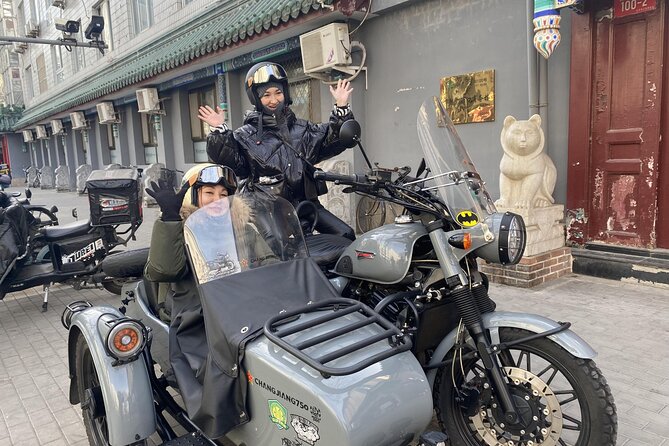
The ride then passes the north gate of the Forbidden City, along with the moat and a watchtower. This is a strong photo section because you see the defensive edge of the imperial complex without spending time inside the palace grounds.
The moat and watchtower give you a sense of scale. From a sidecar, you can take in the broad outer structures and then continue along the road rather than joining the longer process involved in a full Forbidden City visit.
That is also the main limitation. This is an exterior encounter, not a Forbidden City tour. If the palace is your top priority, reserve a separate block of time for it. The sidecar ride works best as a way to frame the city around the landmark, not as a replacement for entering it.
Still, this stop helps connect the earlier sights. You have seen traditional lanes and central-axis buildings, then moved toward one of Beijing’s defining walls and gates. The route gives you a basic mental map, which is especially useful at the beginning of a stay.
Workers’ Stadium and Beijing’s modern city life
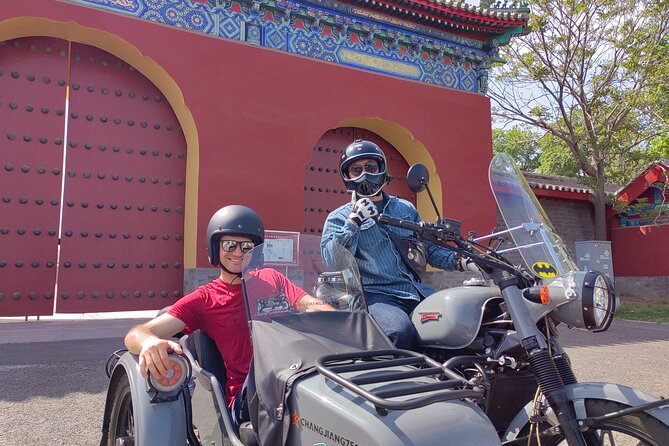
Beijing Workers’ Stadium is a short five-minute stop. The newly built stadium is linked with Beijing’s football scene and gives the tour a very different subject from the old city monuments.
This is a quick exterior look, so do not expect a stadium tour or time inside the building. Its purpose is to show how Beijing uses major public architecture to express its present-day identity.
I like this shift because it prevents the tour from turning old Beijing into a sealed-off display. The city’s sports culture, roads, offices, and new buildings are part of the same story. Seeing the stadium after the hutongs makes that point without a long lecture.
For a football fan, the stop may carry more weight. For everyone else, it is a brief architectural and city-life marker before the route heads into the CBD.
CCTV New Mansion and the CBD skyline
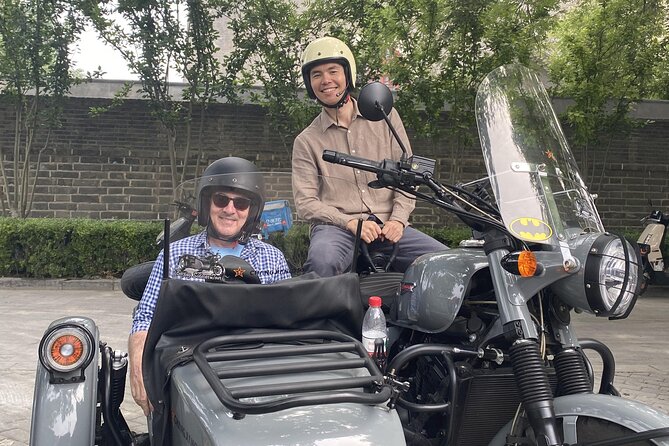
The CCTV New Mansion is another short stop, about five minutes, in Beijing’s central business district. You will also see the tallest building in Beijing according to the supplied tour information.
The CBD section is about scale and design. The bold CCTV building looks nothing like the low hutong lanes, and the change arrives quickly from the sidecar. This is one of the best reasons to choose the tour instead of staying only around the historic center.
There is no promise of going inside the building or visiting an observation deck. You are seeing the architecture from street level, with time for photos and a short explanation. That is enough for a useful introduction, but not a full architecture program.
The sidecar gives you an advantage here: you can experience the transition between districts instead of simply appearing at a tower after a subway ride. You see Beijing change as you move through it.
Ming City Wall Park and the old city edge
The final named stop is the Site of Ming City Wall Park, where about 15 minutes are set aside. It contains the only existing section of the original Beijing intercity wall, according to the tour details.
This stop brings the old and modern themes together neatly. A surviving wall section represents the city’s earlier defensive form, while the surrounding capital continues to grow with new buildings, roads, and public spaces. You get a direct visual contrast rather than a long explanation.
The 15-minute pause gives you more breathing room than the Bell and Drum Towers, Workers’ Stadium, or CCTV stop. You can take pictures, look closely at the wall, and enjoy one last break before returning to the meeting point.
Again, this is not a full historical site visit. The tour focuses on the existing section and the surrounding park. If you want extensive information about Ming military construction or Beijing’s former gates, plan a separate visit with more time.
Day or night: choosing the better departure
The tour runs during the day or at night, so your choice should match what you want to see. Daylight is the safer pick if hutong details, wall textures, and clear photos matter most. It should also make the older parts of the route easier to read.
Night brings a different mood to the modern sections. The CBD, CCTV building, stadium, and city roads can feel more dramatic after dark, while the lake area may offer a pleasant pause with a cold drink. The trade-off is that small alley details and historic surfaces may be harder to see.
The operator requires good weather. If poor weather cancels the ride, you can choose another date or receive a full refund. Since the route depends on an open motorcycle, this is reasonable, but you should avoid placing the tour immediately before a fixed, costly reservation.
What the two-hour schedule really gives you
The timing is brisk. Five minutes at several stops leaves little room for wandering, long meals, or extended historical discussion. The 15-minute pauses at Houhai and the Ming City Wall Park do most of the relaxing work.
That pace suits you if you want a city sampler. You can see many districts and decide where to spend more time later. It suits you less if you prefer to study one building, shop in a neighborhood, or stop whenever something catches your eye.
The route is private, so only your group participates. That gives you more room to ask questions and request reasonable photo pauses than a large coach tour would. It does not mean every stop can expand without limit, since the tour still needs to return in roughly two hours.
The tour accepts group discounts, and larger groups can ask about added availability if they have more than eight people. Tailor-made experiences are also available on request. Those options may be useful for families, friends, or organized groups who want to adjust the emphasis, but confirm the exact price and route before booking.
Comfort, safety, and practical details
The included helmet is the most important item, and the supplied raincoat adds basic protection if conditions shift. The phone charging cable is handy because a short tour can still consume plenty of battery through photographs and navigation.
Service animals are allowed, the activity is near public transportation, and most people can participate. The supplied details do not specify a particular age limit, mobility arrangement, or sidecar weight limit, so ask the operator directly if any of those points affect your plans.
Hotel pickup has been handled by John, and he has also been flexible about where to leave people at the end. The official meeting point remains the National Art Museum, with the activity ending back there, so treat hotel pickup and alternate drop-off as arrangements to confirm rather than automatic promises for every booking.
The sidecar format is best for people comfortable sitting on a motorcycle for about two hours. You should also be ready for wind, road movement, and changing temperatures. The ability to switch seats halfway makes the ride more balanced for two people.
Who should book this Beijing ride
I would choose this tour early in a Beijing stay if I wanted a quick sense of the city’s shape. It is especially useful for first-time visitors who want to connect the old center, lakes, historic defenses, sports architecture, and office districts before planning longer visits.
It also suits couples or friends who like unusual transport and private guiding. The sidecar turns ordinary movement between sights into part of the experience, and the small group means you are not following a large flag through every stop.
Photographers may like the range of settings: narrow hutongs, water, imperial walls, a football stadium, dramatic modern architecture, and a surviving city wall. Just remember that the stop times are short, so this is a fast collection of views rather than a dedicated photography session.
I would be more cautious about booking it for anyone who needs a slow pace, dislikes motorcycle travel, or wants to enter every major landmark. The tour stays mostly outdoors and focuses on seeing many places from the road.
Final decision: a smart introduction with clear limits
You should book the Beijing Ancient and Modern Sidecar Tour if you want a private, lively introduction to central Beijing and enjoy seeing the city from close range. At $89 per person, it offers more than transport: you get a professional driver-guide, a two-person sidecar, snacks, drinks, safety equipment, photo stops, and a route that covers both old neighborhoods and new districts.
I would book it near the start of a visit, ideally with time afterward to return to the places that catch your interest. Choose daytime for clearer historic details and nighttime for modern city views. Skip it if your main goal is long interior visits or a slow walking tour.
The strongest reason to go is the range packed into two hours. The strongest caution is the same thing: the schedule moves quickly. If that balance suits you, this is an entertaining way to get your bearings without spending your first day inside another tour vehicle.
FAQ
How long is the Beijing sidecar tour?
The tour lasts approximately two hours.
What is the price?
The listed price is $89 per person.
Is this a private tour?
Yes. Only your group participates in the activity.
Where does the tour start?
The listed meeting point is the National Art Museum of China, 1 Wu Si Da Jie, Dongcheng District, Beijing.
Where does the tour end?
The activity ends back at the meeting point.
Is pickup available?
Pickup is offered. Confirm the exact pickup arrangement when booking, since the listed meeting point is the National Art Museum of China.
How many people ride in one sidecar?
Two passengers ride in one sidecar. One sits in the sidecar and one sits behind the driver.
Can passengers change seats?
Yes. Switching halfway is possible.
What is included in the tour?
The tour includes helmets, bottled water, a raincoat, a phone charging cable, a professional driver-guide, Beijing special snacks, and seasonal drinks. Winter service includes hot coffee or tea, while summer service includes cold soda or beer.
What happens if the weather is poor?
The experience requires good weather. If poor weather causes cancellation, you can choose another date or receive a full refund.
Just added around Beijing
- Private Transfer to Mutianyu Great Wall with professional driver★ 5.0 · 19 reviews
- camp on the Great Wall overnight with sunrise and sunset on the wall★ 5.0 · 11 reviews
- One day tour to downtown Tianjin from Beijing by high speed train★ 5.0 · 3 reviews
- BusDa:Ancient Great Wall &Badaling Great Wall Full-day Bus Tour★ 4.5 · 6 reviews
- ZANBUS: Trip to the Jinshanling Great Wall Departing at 7:30 AM★ 5.0 · 5 reviews
- Yuxiandu Chinese Royal Cuisine Museum with Show and Royal Banquet★ 5.0 · 4 reviews
- Private Wild Great Wall Hiking tour at Simatai (Challenging)★ 5.0 · 16 reviews
- Wild Great Wall Huanghuacheng Half Day Tour★ 5.0 · 15 reviews
Evening Experiences, compared.

Shanghai Night River Cruise Tour with Xinjiang Style Dining Experience
Read our review →
Great Wall at Gubeikou and Jinshanling Private Sunset Tour
Read our review →
Late Night Food Tour in the Shanghai’s French Concession
Read our review →
Night River Cruise Tour with Xinjiang Style Dining
Read our review →
Sichuan Opera Shu Feng Yan Yun Evening Show Ticket
Read our review →
Great Tang Dynasty Night Show & Dumpling Meal Option
Read our review →Browse the lists this tour appears in