
Reviewed · HALF-DAY
Guangzhou: Textile Hub and Garment Factory Half-day Tour
Guangzhou’s Zhongda Textile Hub shows you how fabric becomes finished clothing in as little as 48 hours. In two fast-paced hours, you move from fabric stalls to garment workshops, with an industry guide explaining how this tightly packed network responds to orders.
I like the direct access to factory owners and order takers, and I like that the tour goes beyond shop fronts into urban villages where workers live and work close to production. The drawback is the pace: two hours is short, the streets can feel chaotic, and this is not a comfortable outing for wheelchair users.
Key points at a glance
- See the full production chain: Follow fabric selection, labels, patterns, sewing, and packing.
- Meet people who make the system work: Speak directly with order takers and garment factory owners.
- Understand China Speed: Learn how nearby suppliers, workshops, and workers respond quickly to small and urgent orders.
- Walk through Zhongda Textile Hub: Explore one of Guangzhou’s most concentrated textile districts with an English-speaking guide.
- Expect an active tour: Wear comfortable shoes and prepare for lots of walking, e-scooters, and crowded streets.
- Best for industry-minded visitors: Sourcing professionals, designers, retailers, supply chain managers, entrepreneurs, and sewing enthusiasts will get the most from it.
Why Zhongda Textile Hub matters
This is not a polished showroom tour. Zhongda is a working textile district, and its value comes from seeing how the pieces fit together in real time.
The area brings fabric sellers, accessory suppliers, label makers, packing providers, order takers, and garment workshops close to one another. That proximity helps explain how a clothing order can move quickly from an idea to a finished product. You are not just looking at rolls of cloth. You are seeing a supply network built around speed and constant contact.
Your guide helps make sense of the movement. Without that context, a textile market can look like a maze of stalls and fabric bolts. With an industry expert beside you, you can ask why certain suppliers are located together, how orders move through the district, and how small factories adjust when a buyer changes a request.
This setting is especially useful if you work in fashion, retail, manufacturing, or supply chain management. It also suits you if you sew as a hobby and want to understand what happens after a designer sends a pattern to a factory.
A few more Guangzhou trips to weigh up
- Private Half-Day Guangzhou City Tour with Pickup
★ 5.0 · 4 reviews - Half-Day Mini Group Xian Tour to Terracotta Warriors Museum
★ 5.0 · 467 reviews - Half-Day Chengdu Cooking Class with a Local Market Visit
★ 5.0 · 465 reviews
Starting at Zhujiang International Textile City
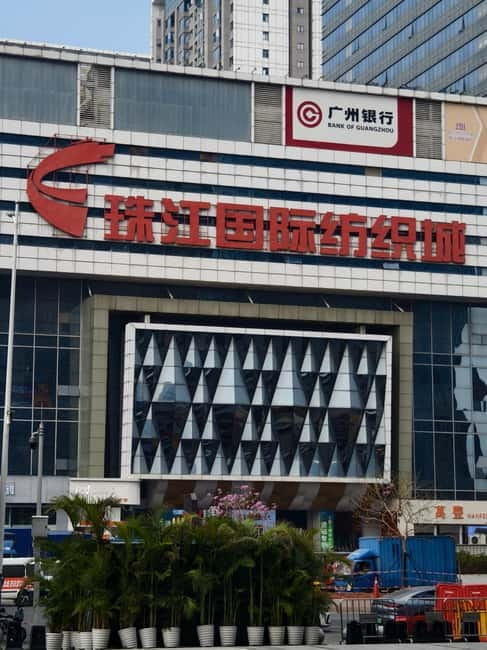
The tour begins at the main entrance of Zhujiang International Textile City Area A, written in Chinese as 珠江国际纺织城A区正门. The meeting point is at a traffic light intersection, in front of the shop called 恒泰超泓.
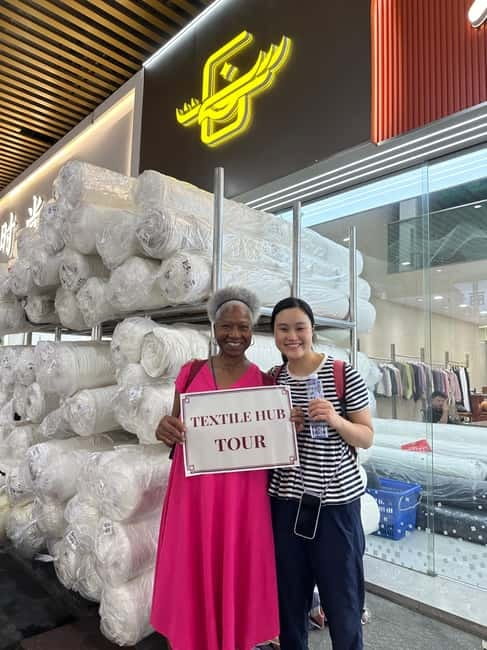
Look for a guide holding a sign marked Textile Hub Tour and the company name Authentic Tour Asia. This detail matters because the surrounding area is busy, with many shops and plenty of foot traffic. Arriving at the correct entrance will save you time at the start of a short tour.
If you use Didi, enter 海珠合生新天地 as your destination. That shopping mall is directly across the street from the meeting point. By subway, take Line 11 to Yijing Lu Station, or 逸景路站, and use Exit C. From there, walk west for about 10 minutes along the main road, with your back to the morning sun.
Allow extra time for finding the entrance. A two-hour tour leaves little room for a late arrival, especially if you are unfamiliar with Guangzhou’s street layout.
The first hour, fabric, labels, and the supply chain
The first guided section takes place around the textile hub. You can expect to see fabric sources and learn how different parts of the clothing process connect.
One useful part of this stop is the chance to examine how fabric is chosen. The focus is not only on finished fashion. You can also learn about labels, patterns, and packaging, which are easy to overlook when buying clothing but essential to a finished order.
The district’s close grouping of suppliers is the main lesson here. A garment maker does not need to search across the city for every part of an order. Fabric, labels, boxes, and production help may all be found nearby. That arrangement helps small businesses act quickly and gives buyers more direct contact with the people handling their orders.
For a fashion entrepreneur, this can be more useful than a general factory visit. You get a clearer sense of where sourcing decisions happen and who you would need to speak with. For a retail or supply chain professional, the visit offers a practical look at how local coordination can reduce delays.
The guide can also help you ask better questions. You might want to ask how a factory handles a small order, how fabric choices affect production, or how designers send patterns. The value of the stop depends partly on your curiosity, so arrive ready to engage rather than simply follow the group.
The second hour, inside small garment factories
The next part takes you into urban villages and garment factories. This is where the tour shifts from materials to people and production.
You can see how workers live and work close to the factories, creating a flexible labor system that can adapt to incoming orders. The setting may feel crowded and informal compared with a modern industrial park. That is part of what makes the visit useful. You are seeing a small-scale production model that depends on close relationships and quick decisions.
A factory owner may show you how patterns from designers are laid out on fabric. You may also see workers sewing garments piece by piece and learn how orders move toward completion. The factory visit gives the process a human scale. Instead of thinking only about production figures, you can watch the individual steps that turn cut fabric into clothing.
Direct conversation is another major benefit. You may speak with order takers and factory owners about their work, production needs, and business relationships. The tour is designed to show how collaboration happens without one central office directing every stage. Each participant handles a part of the work, and the network responds through communication and proximity.
You should keep your expectations realistic. This is a short visit, not a full factory audit or a formal sourcing conference. You are unlikely to assess every production standard or negotiate a complete manufacturing contract in two hours. Think of it as a practical introduction and a chance to make useful contacts.
Same country, a completely different kind of day:
- Guided Cycle Tour of Guangzhou
★ 5.0 · 164 reviews - Customised Private Guangzhou City Tour with Flexible Itinerary
★ 5.0 · 107 reviews - Gulong Gorge Skywalk Glass Bridge and Waterfall View Private Tour
★ 5.0 · 103 reviews - Private Guangzhou Full Day City Tour with Old and New Highlights
★ 5.0 · 62 reviews
What China Speed looks like on the ground
The phrase China Speed can sound abstract until you see the short distances between suppliers and workshops. This tour gives the idea a physical form.
A buyer may need fabric, labels, patterns, boxes, and sewing capacity. In Zhongda, those needs can be handled through a dense cluster of nearby businesses. A factory owner can speak with an order taker, source materials, and adjust production without relying on a distant corporate chain.
The tour also shows why small factories matter. They may not have the size of a major industrial plant, but they can respond to changing orders and flexible quantities. For a new label or small retailer, that adaptability can be important.
The 48-hour claim should be understood as the tour’s central lesson about speed, not as a promise that every garment order will always be completed in exactly two days. Production time depends on the order, materials, design, and factory capacity. Still, seeing the cluster helps you understand how such fast turnaround can be possible.
If you are studying supply chains, this is the point where the tour becomes more than a market walk. You can connect the physical layout of the district with the business habits that support rapid production.
A useful visit for sourcing professionals and sewing hobbyists
The tour is clearly aimed at people working in fashion, manufacturing, retail, and supply chain management. You will get the most practical value if you already have a sourcing question or business idea in mind.
A fashion entrepreneur might use the tour to identify potential partners. A retailer could learn more about how garments are sourced and packed. A supply chain manager could compare this tightly connected model with the systems used at home.
You do not need to work in the clothing industry to enjoy it. Sewing hobbyists can learn how bulk garments are made, how fabric is selected, how labels are produced, and how patterns reach the factory floor. The factory owner’s explanation of laying patterns onto fabric is particularly useful if you want to connect home sewing with commercial production.
The tour can also help you decide if Guangzhou is relevant to your plans. A face-to-face conversation with an order taker or factory owner may answer questions that online searches cannot. You should bring a notebook or phone for notes, though the supplied information does not promise samples, formal quotations, or business introductions after the tour.
The guide makes the difference
The tour is conducted in English by a live industry guide, and the small group is limited to 10 people. That size suits the subject. You have a better chance to ask questions than you would in a large coach group, and a guide can keep the group together through busy streets.
Ceciliaye is one guide associated with the experience. She has been praised for explaining the production process and for taking time to show how patterns, fabric, labels, and packaging fit together. If she leads your tour, ask her to explain any stage that interests you, especially if you want details relevant to your own work.
The small group also matters when speaking with factory owners. A group of 10 can gather around a work area without creating the feel of a large commercial tour. Even so, the environment is active, and conversations may be brief. Prepare a few clear questions before you arrive.
Price, timing, and what you receive
The tour costs $89 per person and lasts two hours. That is not a low-cost market stroll, so the value depends on how much you want direct industry access.
For a sourcing professional or entrepreneur, the price may be reasonable if the visit helps you identify suppliers, understand local production, or make a useful connection. You are paying for an English-speaking industry guide, access to working textile and garment areas, and the chance to speak with people involved in production.
For a casual visitor who only wants to browse fabric, the cost may feel high. You could spend less time and money visiting a market on your own, but you would lose the explanations and factory access that give this tour its purpose.
Transportation, meals, and drinks are not included. You make your own way to the meeting point and return there at the end. Since the tour is only two hours, the lack of private transportation is not a major issue once you reach the starting point.
Free cancellation is available up to 24 hours before the tour for a full refund. You can also reserve now and pay later, which helps if your Guangzhou schedule is still changing.
Walking, noise, and practical limits
Wear comfortable shoes. You will walk through a busy textile district and urban-village streets, and the tour does not suit wheelchair users.
Be ready for a fast and chaotic setting with many e-scooters. Keep your attention on the street while listening to the guide, and do not expect the calm pace of a museum visit. The surroundings are part of the lesson, but they can also be tiring.
Smoking is not allowed. Meals and beverages are not included, so plan those separately before or after the tour.
The short duration is both a strength and a weakness. Two hours keeps the visit focused and fits well into a busy Guangzhou schedule. It also means the tour cannot cover every part of the textile trade. If you want detailed negotiations, factory inspections, or extended supplier meetings, you will need more time than this experience provides.
Who should book this Guangzhou tour?
Book it if you want to understand how a dense textile cluster works and you value direct conversations over polished presentations. It is particularly suitable for fashion entrepreneurs, sourcing professionals, retailers, supply chain managers, manufacturers, and people exploring a new clothing business.
It is also a good match for sewing enthusiasts who want to see commercial garment production from fabric selection through sewing and packing. The factory visit can make familiar sewing concepts feel much larger and more connected.
Think twice if you dislike crowds, walking, traffic, or informal industrial settings. This is not a sightseeing tour built around beautiful views or relaxed browsing. It is a short, practical look at how people, materials, and small factories work together.
Should you book it?
You should book the Guangzhou Textile Hub tour if your interest is in how clothing gets made and sourced, not simply in seeing a fabric market. The direct contact with factory owners, the visit to small garment workshops, and the explanation of labels, patterns, and packing make the $89 price easier to justify for anyone with a professional or serious hobby interest.
Bring comfortable shoes and a few questions. If you are willing to keep pace and pay attention to the working environment, you will leave with a clearer picture of Guangzhou’s fast production network and the people who keep it moving.
FAQ
Where does the tour begin?
It begins at the main entrance of Zhujiang International Textile City Area A, or 珠江国际纺织城A区正门, at a traffic light intersection.
How do I identify the meeting point?
Look for the shop called 恒泰超泓. The guide will stand in front of it with a sign reading Textile Hub Tour and the company name Authentic Tour Asia.
What should I enter in Didi?
Enter 海珠合生新天地 as your destination. The shopping mall is directly across the street from the meeting point.
Which subway station is closest?
Take Line 11 to Yijing Lu Station, or 逸景路站. Use Exit C, then walk west for about 10 minutes along the main road.
How long does the tour last?
The tour lasts two hours. It includes two guided sections of about one hour each and returns to Zhujiang International Textile City.
Is the tour offered in English?
Yes. The activity includes a live English-speaking tour guide.
What is included in the price?
The price includes an expert industry guide, hands-on industry understanding, fabric sourcing information, and opportunities to meet garment factory owners.
Can wheelchair users join?
No. The tour is not suitable for wheelchair users. Comfortable shoes are recommended because there is a lot of walking.
Just added around Guangzhou
- Big Buddha Mountain Martial Art Culture Countryside Private Tour★ 5.0 · 31 reviews
- Hong Kong One Day Private Tour from Guangzhou by Bullet Train★ 5.0 · 3 reviews
- Day Tour learning Kung Fu and Lion Dance in Bruce Lee’s Hometown★ 5.0 · 7 reviews
- Glass Bridge and Water Falls Private Car Service from Guangzou★ 4.5 · 3 reviews
- Seven Star Crag and Dinghu Mountain private day tour from Guangzhou★ 5.0 · 5 reviews
- Seven Star Crags Karst Cave Mirror Lake Bird Islands Private Tour★ 5.0 · 30 reviews
- Private Tour: Guangzhou City Sightseeing Including Yuexiu Park★ 3.5 · 3 reviews
- Private flexible Guangzhou City Sightseeing Tour with Dim-Sum Tasting★ 5.0 · 5 reviews
Half-Day, compared.
Half-Day Mini Group Xian Tour to Terracotta Warriors Museum
Read our review →
Half-Day Chengdu Cooking Class with a Local Market Visit
Read our review →
Private Half-Day Chengdu Panda Breeding Center Tour with Optional Volunteer
Read our review →
Half-Day Bike Tour of Shanghai Old Town with Food Tasting
Read our review →
Private Half-Day Tour of Xi’an Terracotta Warriors
Read our review →

Half-Day Private Zhujiajiao Water Town Tour with Boat Ride from Shanghai
Read our review →Browse the lists this tour appears in