
Reviewed · TERRACOTTA WARRIORS TOURS
Terracotta Warriors Museum Ticket with Professional English-speaking tour guide
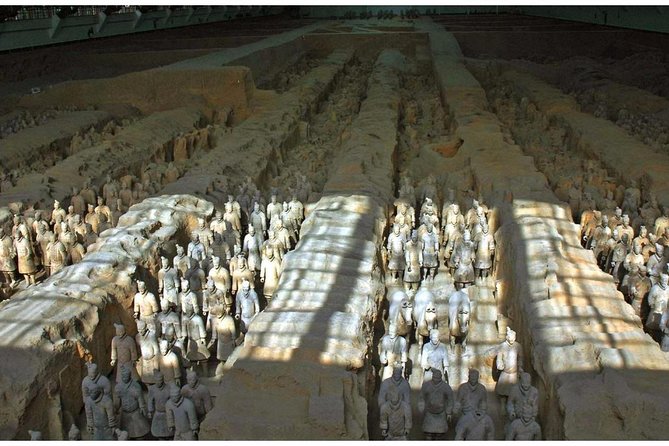
The main pit is a jaw-dropper: row after row of life-size clay soldiers, horses, and broken figures spread beneath an enormous hangar-like roof. This tour gives you the essential route through Pits 1, 2, and 3, with an English-speaking guide to explain what you are seeing instead of leaving you to puzzle over a sea of statues.
I like the skip-the-line entry, especially when the museum is crowded, and I like the practical help a guide can provide inside. Chelsea, Cynthia, Aurora, Peter, Alice, and other guides have earned praise for clear English, useful stories, photo advice, and patience with questions.
The main caution is crowd control. This is a popular site, and a few guides have been accused of rushing or pushing shopping stops. Confirm what is included, arrive at the stated meeting point on time, and make it clear if you want a slower visit with no shopping detours.
Key points to know before you book
- Pits 1, 2, and 3 are included: You see the main excavation halls rather than only the famous central pit.
- The Bronze Chariots Exhibition is part of the visit: It adds finely made bronze pieces to the larger story of Qin burial power.
- English explanations are the main value: Guides explain the emperor, the tomb project, excavation, restoration, and the figures themselves.
- The museum is outside central Xi’an: Your own transport is needed because an air-conditioned vehicle is not included.
- Plan on two to three hours: That is enough for a focused visit, though a crowded day can affect your pace.
- Ask for a no-shopping tour: Most of the praise centers on the museum guiding, while a few complaints involve pressure to meet sellers or buy items.
Why the Terracotta Army is worth your afternoon
The Terracotta Army is not a small display of ancient statues. It is a huge underground military force created for Qin Emperor Ying Zheng, the ruler who unified China’s six warring states more than two thousand years ago.
The scale is the first thing you feel. Soldiers stand in formation with different faces, hairstyles, clothing details, and poses. Horses and chariots add movement to an otherwise silent army. Many figures are incomplete, and that is part of the appeal. You are looking at an active archaeological site as well as a finished museum display.
The construction story is just as striking. The emperor began his mausoleum at age 13. Nearly 720,000 workers and 38 years were used to complete the vast burial project. A guide gives those numbers meaning by connecting them to Qin power, imperial ambition, and the ancient belief that an emperor needed an army in the next life.
I would not treat this as a quick photo stop. The figures are impressive on their own, but the experience becomes far more interesting when you understand why they were made, how they were arranged, and what the excavation has revealed.
More English Speaking Guides in China
- Private Mutianyu Great Wall Trip with English-Speaking Driver
★ 5.0 · 927 reviews - Private Mutianyu Great Wall Trip With English-Speaking Driver
★ 5.0 · 899 reviews - Private Mutianyu Great Wall Flexible Trip English Speaking Driver
★ 5.0 · 205 reviews
Meeting your guide and entering the museum
This experience does not include hotel pickup. You meet the guide at the museum ticket office or at the stated museum meeting point, and contact details are provided in advance. Several guides have used WeChat to coordinate with visitors, which can be especially useful when you are trying to find one another in a crowded entrance area.
Your guide handles the included admission ticket and takes you through the entrance. The promised line-skipping matters here because the museum can become extremely busy, particularly during national holidays and other peak periods.
Do not assume that skip-the-line means an empty museum. It means you avoid the regular ticket queue, not the crowds inside the halls. One guide reportedly found a small group in a mass of thousands without trouble, while another helped visitors move through heavy holiday crowds. That kind of practical assistance can save time and frustration.
Some guides provide a small headset so you can hear the commentary clearly. This is useful in the large pits, where voices can disappear into the noise. It is worth confirming at the start whether your group will use one.
Pit 1: The great hall and the famous army
Pit 1 is usually the emotional center of the visit. This is where the scale becomes almost difficult to take in. You look down over long ranks of soldiers, many restored from fragments, with horses and military formations extending into the distance.
The first few minutes can be overwhelming. You may want to photograph everything, but a guide helps you slow down and notice details. Look at the differences in faces, clothing, armor, and posture. These are not identical factory-made figures. Their variety gives the army a human quality, even though their purpose was to serve an emperor in death.
The broad view is essential, but do not spend the whole time at the railing. A good guide points out restoration work, broken sections, and the way archaeologists have reconstructed the formations. Chelsea, Cynthia, and Peter were especially praised for explaining the main points clearly and helping with photographs.
Pit 1 can also be the most crowded area. One useful suggestion is to begin with Pits 2 or 3 and finish at Pit 1 later, especially if you arrive near opening time. This is not guaranteed to produce a quiet visit, but it may help you avoid facing the thickest crowd immediately.
Pits 2 and 3: Smaller spaces with useful detail
Pits 2 and 3 do not have the same visual punch as Pit 1, but they are important parts of the visit. They help you see different excavation conditions and military arrangements rather than one enormous field of figures.
Pit 2 can reward a closer look at the range of figures and the way archaeologists work with damaged remains. Pit 3 is smaller and gives you a different sense of the complex. The contrast between the pits keeps the visit from becoming one long repetition of soldiers in rows.
This is where the guide’s role becomes particularly useful. Without context, you might rush through the smaller halls after seeing Pit 1. A clear explanation helps you understand why each pit matters and what is still being studied.
The tour includes access to the First Emperor’s Terracotta Army Exhibition Area, covering all three pits. That is a strong point for the price because you are not paying simply to enter the main hall and leave. You get a structured route through the core museum area.
More Terracotta Warriors Tours in Xian:
- Mini Group Xian Day Tour to Terracotta Army, City Wall, Pagoda and Muslim Bazaar
★ 5.0 · 1,320 reviews - Xi’an: Terracotta Army Mini Group or Private Tour
★ 5.0 · 926 reviews - Xian: Terracotta Army Ticket & Guided Bus Tour with Options
★ 4.6 · 579 reviews - Customized Private Day Tour of Terracotta Warriors and Xi’an
★ 5.0 · 513 reviews
The Bronze Chariots Exhibition
The Bronze Chariots Exhibition adds a different kind of spectacle. The large clay army gives you scale and military power. The bronze chariots bring you closer to craft, detail, and imperial display.
Your guide explains how the chariots fit into the burial complex and the emperor’s vision of life after death. They are a useful contrast to the rough, damaged excavation areas. After looking across thousands of soldiers, it can be refreshing to focus on carefully made bronze objects.
The supplied details also refer to the mausoleum site as part of the visit. The exact amount of time spent there can depend on the guide’s route and the group’s pace, so ask at the beginning if seeing that area is a priority for you.
What the English-speaking guide adds
The strongest reason to book this experience is not the entrance ticket. You can visit a famous museum without a guide. The extra value comes from turning a large archaeological site into a readable story.
A good guide can explain:
- Why Qin Shihuang created the army
- How the emperor’s mausoleum project was organized
- What makes the soldiers different from one another
- How the pits were excavated and restored
- Which sections deserve your closest attention
- Where to pause for photographs
- How to move through the museum when crowds are heavy
Several guides have received especially strong praise. Chelsea is repeatedly described as friendly, articulate, patient, and good at answering questions. Cynthia is praised for delivering a clear two-hour introduction. Aurora is noted for calm explanations and useful suggestions, while Peter helped with tickets, photographs, and hearing the tour through a headset.
Alice suited visitors who wanted help with the museum but did not need transport or extra attractions. Wangkai, Jimmy, Freya, Nancy, and Christina are also named as guides who made the visit more understandable or enjoyable.
That does not guarantee which guide you will receive. Guide quality can vary, and one guide repeated information too often. Another tried too hard to steer the group toward a farmer or shopping experience. Set your expectations early: say that you want the museum tour only, and that you are not interested in buying items.
Crowds, timing, and the two to three-hour schedule
Two to three hours is a sensible estimate for a focused museum visit. It gives you time for the three pits, the Bronze Chariots Exhibition, explanations, and photographs without turning the outing into an all-day commitment.
The actual feel of the tour depends heavily on crowd levels. During a holiday, the main pit may be packed, and moving from one viewing point to another can take patience. You may need to take photographs between groups rather than waiting for a completely clear view.
If you have a once-in-a-lifetime interest in the site, tell the guide that you do not want to rush. One lower-rated experience involved a small group and a good English-speaking guide, but the visitor still felt hurried and wanted more time for photos. The tour is designed as a compact introduction, not an unlimited private archaeology session.
A private or nearly private group can make a big difference. The advertised product mentions group discounts, and the experience can sometimes feel very personal when only a few people book. Still, you should not assume a private tour unless your booking specifically says so.
Price and what the $45.87 covers
At $45.87 per person, this is not the cheapest way to walk through a museum. The entrance ticket is included, along with access to Pits 1, 2, and 3 and a professional English-speaking guide.
You are mainly paying for convenience and interpretation. The line-skipping entry can be valuable on a busy day, and an experienced guide may help you see the important parts in two hours instead of wandering without a plan. The price also avoids the uncertainty of approaching guides at the ticket office and haggling over a last-minute rate.
The value is weaker if you already know the site well, speak Chinese, or prefer to read displays at your own pace. It is also less complete than a full day excursion because lunch and transport are not included.
For most first-time international visitors, I consider the price reasonable if the guide is strong and the meeting arrangement works as promised. The high overall score of 4.6 from 53 ratings supports that view, though the complaints about organization, rushing, and sales pressure should not be ignored.
Transport, lunch, and planning details
You must arrange your own way to the museum. An air-conditioned vehicle is not included, and hotel pickup is not part of the experience. This makes the tour a good fit if you already have transport sorted or want a guide-only museum visit.
Lunch is also excluded. Some guides have suggested nearby restaurants, and one helped a visitor find a place to eat after the tour. Treat that as personal assistance rather than a promised meal.
You receive confirmation at booking, and the experience is listed as suitable for most people. The tour requires good weather. If poor weather causes cancellation, you are offered another date or a full refund.
Free cancellation is available up to 24 hours before the start time. Changes or cancellations inside that window are not accepted for a refund, so keep the local cutoff time in mind when planning a tight Xi’an schedule.
Who should book this experience
I would choose this tour if you want the major sights explained in clear English and you do not need transport. It suits first-time visitors, couples, families with older children, and anyone who wants to understand the site rather than simply take photographs.
It is also useful for visitors who dislike negotiating at the entrance. Having a named contact, a prearranged ticket, and a guide waiting at the museum can remove a fair amount of stress.
You may prefer another arrangement if you want a long, slow archaeological visit, private access to a pit, or a full-day outing with meals and transportation. Private pit access is not included in the information provided here, so do not book this experience expecting that feature.
Should you book the Terracotta Warriors Museum tour?
Yes, if your priority is a practical two to three-hour introduction with museum admission, line-skipping entry, and English explanations. The best guides, including Chelsea, Cynthia, Aurora, Peter, and Alice, appear to add real value by explaining the figures, handling crowds, and answering questions.
Book with realistic expectations. You will still face crowds, arrange your own transport, and pay separately for lunch. Tell the guide that you want time for photographs and no shopping stops. If those conditions work for you, this is a good-value way to make sense of one of Xi’an’s most astonishing sights.
FAQ
How long does the Terracotta Warriors tour last?
The experience lasts approximately two to three hours.
Is the entrance ticket included?
Yes. Admission to Emperor Qin Shihuang’s Terracotta Warriors Museum is included.
Which museum areas are included?
The tour includes the First Emperor’s Terracotta Army Exhibition Area, including Pits 1, 2, and 3. The Bronze Chariots Exhibition is also included in the described visit.
Is an English-speaking guide provided?
Yes. A professional English-speaking tour guide is included.
Does the tour include hotel pickup?
No. Hotel pickup is not included, and you meet the guide at the museum ticket office or stated meeting point.
Is transportation included?
No. An air-conditioned vehicle is not included.
Is lunch included?
No. Lunch is not included, although a guide may suggest or show you a nearby restaurant.
Can I cancel for a full refund?
Yes, if you cancel at least 24 hours before the experience start time. Cancellations made less than 24 hours beforehand are not refunded.
More Museums in Xian
- Half-Day Mini Group Xian Tour to Terracotta Warriors Museum
★ 5.0 · 467 reviews - Private Xi’an Tour: Terracotta Warriors, Hanyangling Museum, Cave Homes
★ 5.0 · 101 reviews - Xi’an: Terracotta Army Museum Group Tour
★ 4.5 · 85 reviews - Xi’an Full Day Sightseeing Tour – Shaanxi History Museum, Big Wild Goose Pagoda, Ancient City Wall
★ 4.5 · 26 reviews
Just added around Xian
- Top 3 Xian Sites to Terracotta Army & Dinner Show w/ Options★ 4.7 · 11 reviews
- The Legend Of Camel Bell In Xi’An★ 5.0 · 4 reviews
- Terracotta Warriors And Xi’An DowntownTour★ 5.0 · 6 reviews
- Terracotta Army, Huaqing Palace & Song of Everlasting Sorrow★ 5.0 · 3 reviews
- Terracotta Army Day Tour from Xi’an-Tickets&Flexible Pickup★ 5.0 · 8 reviews
- Terracotta Army E Ticket with Optional Transfer or Guide★ 5.0 · 32 reviews
- Private Xian Mt. Huashan Adventure Tour: Explore in Your Own★ 4.9 · 6 reviews
- From Xi’an: Mt. Huashan Private Tour and Cable Car Ride★ 4.8 · 3 reviews
Terracotta Warriors Tours, compared.

Mini Group Xian Day Tour to Terracotta Army, City Wall, Pagoda and Muslim Bazaar
Read our review →
Terracotta Army Ticket & Guided Bus Tour with Options
Read our review →
Customized Private Day Tour of Terracotta Warriors and Xi’an
Read our review →
Exclusive Terracotta Army Tour & Local Family Lunch
Read our review →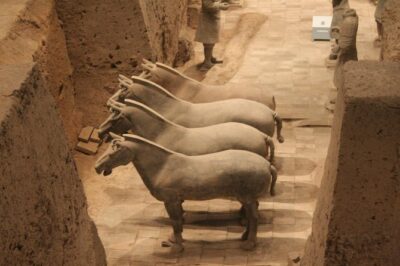
Half-Day Mini Group Xian Tour to Terracotta Warriors Museum
Read our review →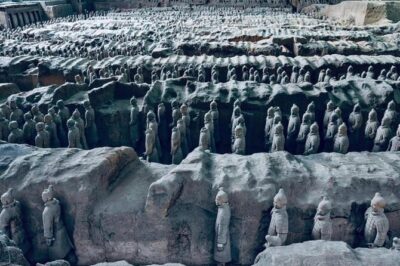

Private Customizable Terracotta Warriors Day Tour with Options
Read our review →Browse the lists this tour appears in